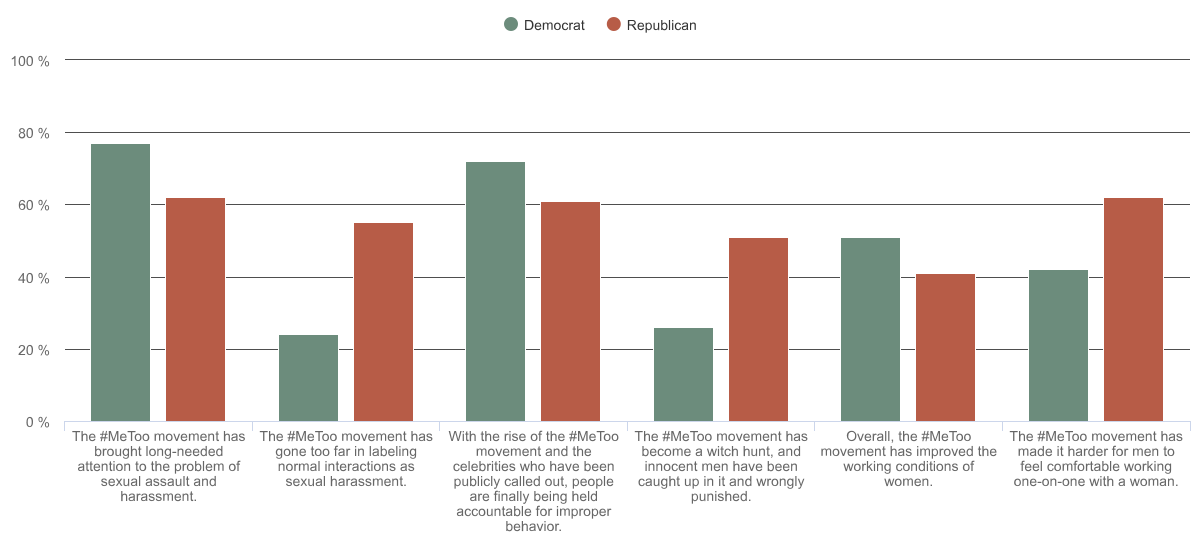
When considering reactions to discrimination and harassment cases, attitudes toward the #MeToo movement are highly relevant; with few exceptions, attitudes strongly correlated with respondents’ prevalence estimates of unequal treatment based on both race and gender. Stated differently, the more positive (or less negative) people felt about the movement, the higher their prevalence estimates of these forms of unequal treatment. Thus, these attitudes may offer insight into prospective jurors’ likely reactions to a workplace discrimination or harassment case.
Strategic Implications and Recommendations
The data from DOAR’s 2018 and 2020 studies deliver a clear message that many factors come to bear on how third parties will evaluate the themes lawyers advance on their clients’ behalf. The life cycle of a dispute may be brief, never resulting in litigation, or protracted, meandering through the appellate process for years before the court ever empanels a jury. During this interim, many people may form opinions about the case and feel they have a stake in its outcome, including a corporate client’s workforce, shareholders, customers, and competitors; the plaintiff’s friends, family, and prospective employers; and the news media. Clients recognize that even if the case never goes to trial, they will be judged by many. And, in an era when the language used by lawyers in a pleading can trigger sensational headlines and reflect poorly on clients, many of them consider internal and external messaging about the litigation crucial to their wider business interests. Accordingly, performing surveys and jury research throughout the lifecycle of the matter can help craft litigation strategies compelling in both the court of public opinion and a court of law.
Discovery Strategies
Engage Subject Matter Expert Witnesses Early in the Case to Aid In Theme Development
Outside counsel and expert witnesses report seeing an increase in the severity of the sexual harassment alleged since the #MeToo movement took off. Rather than the crude commentary and boorish behavior more likely to be reported in the early years of sexual harassment litigation, #MeToo era harassment cases frequently involve serious allegations of sexual assault and rape and, sometimes, also involve criminal charges. Because sociopolitical attitudes play such a key role in employment disputes, developing themes that will resonate positively with third parties (such as prospective employers and colleagues for plaintiffs and other employees, vendors, and business partners for defendants), as well as manage public perception, may be an integral part of a client’s litigation strategy from the very outset of a sensitive harassment or discrimination matter. DOAR’s expert witnesses – including its human resources experts, industrial psychologists, and forensic psychologists– have performed extensive research into issues such as organizational tolerance for sexual harassment (“OTSH”) and its impact on human resources personnel in the performance of investigations; the connection between sexual harassment and interpersonal violence; and the link between power dynamics and sexual harassment. They often provide testimony attacking or supporting the soundness of a company’s policies and procedures, the fairness and diligence of an investigation, or the criteria for selecting individuals for hiring or promotion. These experts – who have consulted and testified for both plaintiffs and defendants – work with counsel to uncover and examine nuanced root issues that help explain a case to the jury.
Informal polling of DOAR experts in various disciplines yields nearly one universal answer: “I could be so much more helpful if I were involved earlier.” Often, by the time counsel engages an expert, fact discovery is wrapping up, and document production is complete. Documents and other information the expert considers necessary to render a complete analysis of the issues may not have been requested, produced, or examined in depositions, leaving the expert to form an opinion without critical data and their
report vulnerable to attack by the opposing party. The sooner the conversation between experts and counsel begins, the better experts can assist with gathering information critical to the expert’s specific analysis. To facilitate this, our experts say they would like to review interrogatories and document requests before counsel sends them to the other side to ensure collection of necessary documents and data. Likewise, experts also express the desire to review written discovery requests from the other party and confer with counsel in preparing and responding to Rule 30(b)(6) topics.
Experts in economic and emotional damages, as well as industry compliance standards, also shared the following thoughts:
- Retain the expert early on! The damages expert will need information that will come from deposition testimony and will need to request financial information, sometimes from the IRS and/or Social Security Administration, that will take time to obtain. The earlier we are involved in a case, the more time we have to perfect the discovery requests and, therefore, our analysis. Talk to us before you depose critical witnesses so that we can relay any questions we may have for you to ask them.
- Retain the expert before fact discovery ends. This way, the expert can convey and discuss the standards in their field so that the attorney is better equipped to ask questions that elicit responses that are most useful to the expert when they write their report.
- If necessary, use a team of experts, and allow us to communicate with each other so that we can form a unified approach. No one can be an expert in every subject. It can sometimes be beneficial for the economic damages expert to work in tandem with an industry-specific expert, vocational expert, or both. When multiple experts are involved, it is also a good idea to confer [orally] and confirm that no opinions are contradictory to each other before opinion reports are issued in writing.
- Ask us for our input regarding cross-examination of the opposing side’s damages expert in our area of expertise, as well as experts that might be outside our particular expertise, but whose role in determining damages may overlap with ours. For example, the economist may have points for cross-examination for not only the opposing economist but also the vocational expert or industry expert.
Leveraging the power of expert witnesses as soon as possible can help counsel for both plaintiffs and defendants develop a framework for maximizing the client’s return on investment in an expert witness.
Use Subject Matter Experts to Establish a Broad Framework for the Entire Case
Counsel may also extrapolate broad case strategies from an expert’s relatively narrow subject matter expertise. Consider, for example, the strategy used by prosecutors in the Bill Cosby and Harvey Weinstein criminal rape trials, which both ended in convictions. In each case, prosecutors engaged a forensic psychiatrist to testify regarding the behavior of rape victims. In the Weinstein case, the expert testified that it is not unusual for some victims of sexual assault to maintain communication and an ongoing relationship with their attacker. This helped the prosecution establish a context for emails, text messages, and other contact between the victims and Weinstein that explained the victims’ actions long before the defense ever even introduced damaging and potentially contradictory documentary evidence. In contrast, in a recent DOAR focus group that involved similar issues but no expert testimony, mock jurors struggled with this same type of evidence, vigorously debating the reasonableness of the parties’ actions and the consensual nature of sexual encounters. Ultimately, many mock jurors concluded that the alleged victims’ friendly communications with the alleged attacker after the encounter completely undermined the assault claims.
Another subject matter expert recently helped counsel retool not only its general approach to the case within the expert’s area of study but also the damages’ expert’s rebuttal report. At bottom, all the allegations in the case rested upon the presumed accuracy of the plaintiff’s systems for measuring production. The subject matter expert examined these systems and found various fallibilities that undermined its reliability. The expert’s report on this system provided not only a defense to the alleged facts of the case but also a solid foundation for the damages’ expert’s rebuttal report opposing the other party’s calculations.
Trial Strategies
Test and Explore Case Strategies Through Pre-Trial Jury Research
DOAR regularly performs extensive research in harassment and discrimination cases through its expert jury consultants who test and explore case themes and strategies through surveys, focus groups, mock arbitrations, and mock trials. As with subject matter expert witnesses, clients sometimes do not engage DOAR to perform research until shortly before trial. Other times, clients will perform various types of research through the life cycle of the matter to test themes, witnesses, and communications strategies. When clients perform pre-trial research with enough time left in the discovery period, mock jurors can provide feedback that:
- (1) drives the retention of subject matter experts to explain certain aspects of the case;
- (2) highlights the need for testimony from lay witnesses who had previously not been considered central to developing the facts; and,
- (3) posits a theory of the case that makes great sense itself as the theme for trial.
At any stage of litigation, though, pre-trial research is invaluable for the insight it can provide to the trial team. Focus groups, mock trials, and other research activities allow counsel to test case themes and assess the impact of key evidence on fact-finders and decision-makers.
In light of DOAR’s survey findings presented here, it is especially useful to hear in pre-trial research how people bring their personal experiences and expectations to bear on the facts of a particular case. Jurors often serve as their own “experts” in employment cases, judging the parties’ actions in part by what they personally have done or believe they would have done in similar situations. The more you know about the range of opinions jurors are likely to hold – and what types of people are likely to espouse what opinions – the better prepared you are to encourage, pre-empt or rebut these opinions with your trial strategy. Consider, for example, the comments below that were raised by research participants in various focus groups and mock trials on employment cases:
“Technically speaking, he was harassing her –he was her supervisor, boss, mentor – once she tells him she’s not interested …”
— [male juror]
“But she never told him that! She never said that!
— [several female jurors interrupting male juror]
“They had a rule of thumb – you have to let the person who is harassing you know- you have to tell them you are uncomfortable – if you don’t say something, you will continue to be harassed.”
— [female juror]
“I am a manager of a very big chain. I just took the sexual harassment course…. Just because she didn’t say it was unwanted doesn’t mean it was wanted. Under no circumstances should any supervisor at any level above you or below you be touching your lower back or kissing you or hinting at things… Unless it’s consensual, it’s sexual harassment, and I don’t see her consenting to this, or I don’t think she would have filed this.”
— [female juror]
“If he had been accused before, I would be more on her side because there is a pattern. It’s always several people. If there are no other people coming out saying this happened …. It’s not just one – that’s not how it happens.”
— [female juror]
“The person in charge of investigating this should have been fired because he made no effort to protect this young lady. He made no effort.”
— [male juror]
“[Employers] do not like bad publicity. They have a motive to keep things quiet. The employer made an effort to keep this woman quiet.”
— [older male juror]
“I have to hear from more than one source that the [plaintiff] was not performing his job when there were positive reviews in his file. I can’t see someone going from satisfactory to horrible in that short a period of time. If he were that bad, why would he have been recommended before?”
— [female juror]
These quotes demonstrate the underlying assumptions about gender relations or workplace norms that powerfully shape jurors’ interpretations of and reactions to case facts and evidence. The more you know about these assumptions, the less likely they will be to derail your arguments to a jury.
Finally, pre-trial research can be a valuable tool in guiding settlement decisions. At every stage of litigation, empirically obtained estimates of the strength of a case (and defendants’ likely exposure) help attorneys and their clients make informed decisions.
Implications for Voir Dire: Jurors Are Not Blank Slates
When a juror enters a courtroom for voir dire in an employment case, (s)he brings in a lifetime of attitudes and, especially, relevant life experiences. Questioning each juror about these experiences is especially important.
When defending employers against harassment and discrimination claims, push for inclusion of questions about personal experiences, including experiences of “people close to you.” Vicarious experience matters here, and those with experience – personal or vicarious – are risky for the defense. If possible, advocate for a supplemental questionnaire to allow jurors to disclose in private what they might be more reluctant to disclose in public. If that is not possible, ask the Court to construe the experience questions as broadly as possible so that jurors can answer affirmatively without revealing the specific nature of their experience until they are at sidebar (should they wish to approach).
Consider the Juror Profile in Your Peremptory Challenges
What broad groups are more likely than others to be plaintiff jurors?
Our findings strongly indicate the usefulness of political affiliation and political beliefs as proxy variables for employment attitudes. Whenever possible, conduct internet searches of prospective jurors. Political party affiliation can easily be found in online proprietary databases, and social media users with low privacy settings will often post about involvement in or support for key political causes. A word of caution here: When undertaking searches, counsel must educate themselves about the legal constraints of such searching (e.g., what
constitutes “communication” with jurors, and how to do “clean” searches, as well as the law and ethical rules of the particular jurisdiction) or retain consultants with expertise in this area. It is disconcertingly easy to run afoul of the law in researching prospective jurors online; failing to exercise due caution could have dire consequences for the client and counsel.
Frame Arguments with Attention to Context
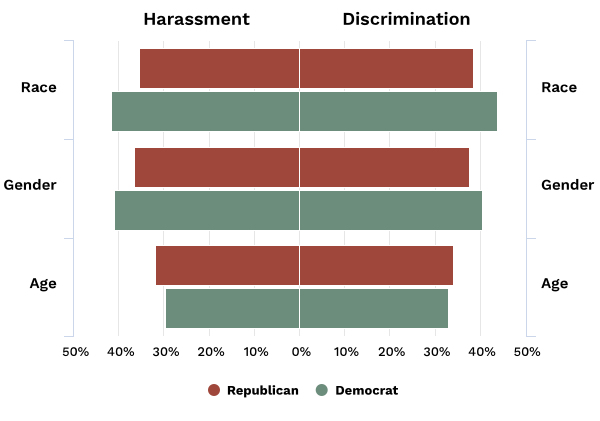
The findings of this study suggest that for jurors, beliefs about discrimination and harassment line up with broader political orientation, but not necessarily other key issues. Plaintiffs may take advantage of this by nesting an employee’s experience within a larger context of social inequality, while defendants will benefit from explicit reminders to jurors that a personal, rather than a national story, is being litigated in the courtroom. Regular reminders of the individuals and the setting can help defense counsel keep the focus narrow, while more expansive terminology can help plaintiff’s counsel remind jurors of the broader social conditions in which the case is being tried.
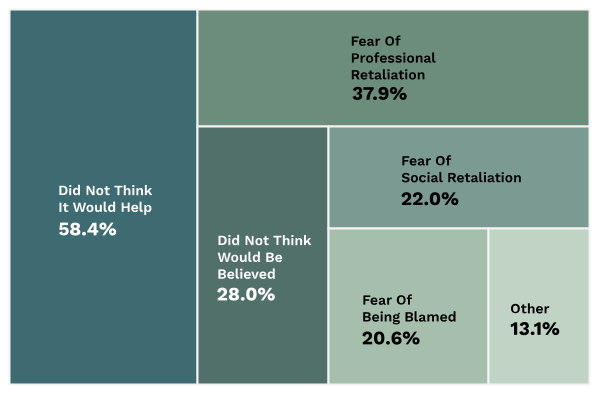
The findings of DOAR’s study also highlight a specific challenge for defense counsel: Jurors are likely to believe that companies retaliate against those who report harassment and discrimination. The survey data suggest that through this presumptive belief in the likelihood of retaliation, jurors may psychologically shift the burden to employers despite legal instructions to the contrary. These presumptions, when combined with personal experiences of harassment and/or discrimination, may result in a relatively high level of juror sympathy for employees who testify that they did not report discrimination or harassment for fear of retaliation. Accordingly, aggressive cross-examination as to the employee’s failure to report is a risky strategy. Rather than focusing on the employee’s failure to report, which can easily be understood, defense counsel may mitigate such risk by framing questions carefully to emphasize the absence of evidence that the employer knew the alleged discrimination or harassment occurred, which may be difficult for the employee to deny. Likewise, emphasizing any positive aspects of the employer’s response and handling of the situation may go further to diminish jurors’ presumptive beliefs about retaliation and paint the employer in a more friendly light.
Consider #MeToo Backlash