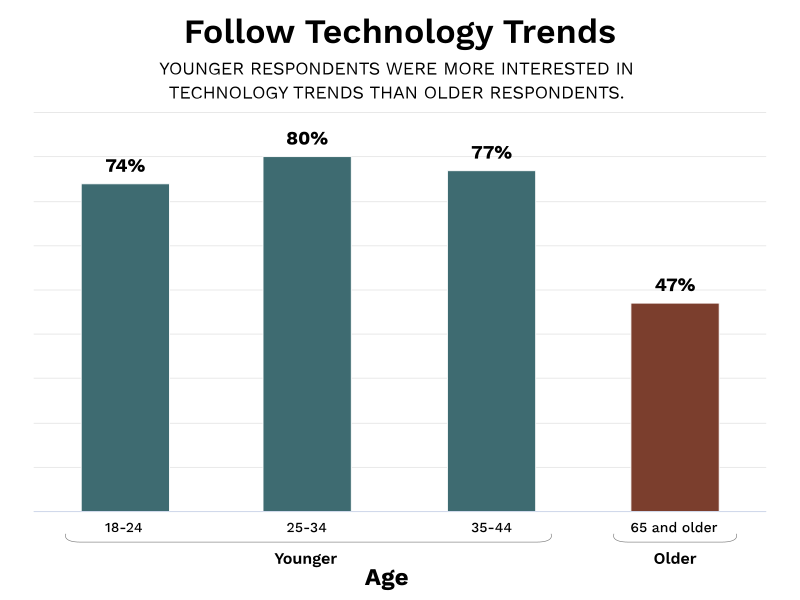
Nevertheless, results show that respondents value the technology and the innovation that foreign tech companies offer. For example, the majority of respondents (59%) believed foreign tech companies make better products than American tech companies. Notably, this belief is held by the majority of Californians, Texans, and Delawareans alike. Data shows, however, this belief is more prevalent among African Americans (69%) and Hispanics (75%) as compared to whites (53%), those without 4-year college degrees (63%) as compared to those with 4-year college degrees (51%), and younger respondents (74% age 18-24; 70% age 25-34) as compared to older respondents (52% age 55-64; 42% age 65 or older).
Many also see foreign companies as being top innovators when it comes to new technologies. We asked respondents to identify countries they consider to be leaders in innovation from a list that included North American, Asian, and European countries. Not surprisingly roughly two-thirds of respondents chose the United States as a top innovator. Interestingly, nearly the same amount identified China as a leader in innovation. In fact, the majority of respondents, regardless of venue, age, race, gender, education, income, and political affiliation named the U.S. and China as leaders in innovation. The only other country to be identified by a majority was Japan (52%). However, only the majority of Californians and West Texans identified Japan as a top innovator (55% and 52% respectively). Less than half of East Texans and Delawareans did (48% and 49% respectively).
Patent Validity
Challenging a patent’s validity is always a focus for defendants facing infringement claims, despite the fact that few juries ever render a patent invalid. Most jurors are simply too reluctant to contradict the work of patent examiners when it comes to advanced technology. To shed light on who might be more willing to invalidate a patent we examined attitudes centering on the competence of government examiners in awarding patents.
We asked respondents how likely it is for government experts to make a serious mistake when evaluating whether a piece of new technology deserves a patent. Responses ranged from “very likely” to “not likely at all.” For the purposes of this analysis, we compared those who believed it was “very likely” the government examiner could make a serious mistake with all others.
Overall, analyses show that East and West Texans are more likely to think serious mistakes are very likely. Thirty-seven percent of East Texans believed that serious mistakes were very likely. Only one-quarter of Californians and 21% of Delawareans shared these beliefs. Additionally, Republicans are more likely than Democrats to think serious mistakes are very likely (29% versus 23%) and higher than average earners are more likely than lower than average earners to think serious mistakes are very likely (30% versus 23%). As these results demonstrate, however, the vast majority of respondents think that serious mistakes are not commonplace.
In the 2020 survey, we analyzed different subpopulations within each venue to identify any subpopulation where the majority distrusted the government only to issue patents when they are truly deserved. Analyses revealed that in the Northern District of California the majority of young men did not trust the government to only issue patents when they were deserved. These results indicated this group would be the most receptive to invalidity arguments.
We conducted the same analyses here but focused on perceptions that serious mistakes were very likely. And indeed, we identified subpopulations in which the majority believed serious mistakes were very likely. Specifically, we found the majority of more educated (59%) and higher income (54%) respondents in the Marshall Division thought serious mistakes were very likely. Although the EDTX sample was relatively small (n=107), the potential impact of this finding outweighed its limitations. In short, this data suggests that higher educated and higher income respondents in the Marshall Division will be the most receptive to invalidity arguments.
Highly Paid Experts
Intellectual property disputes are often won or lost on the backs of expert witnesses, especially for cases that focus on the details of the technology at issue. Finding the right expert can be exceptionally challenging. In the survey, we examined public attitudes that pertain to two aspects of expert selection, the type of expert and cost. First, we asked respondents if they had to learn about advanced technology, who they would most like to hear from. Option A was a retired executive from a tech company who has experience with the technology but does not have a Ph.D. Option B was a college professor with a Ph.D. who has studied the technology but does not have significant experience in the industry. Results showed that most respondents, regardless of venue, preferred to learn about advanced technology from a retired executive rather than a college professor (73%-79%).
While there was some difference between Republicans and Democrats (83% of Republicans preferred executives versus 74% of Democrats) and the oldest and youngest respondents (87% of those 65 or older preferred executives versus 63% for those age 18-24), most favored a retired executive over a college professor.