
Introduction
In 2024-25, the DOAR Research Center conducted a new study to assess how attitudes toward key patent litigation venues have evolved in light of recent developments. This updated research builds on our 2020 study, which was launched in response to the 2017 Heartland decision that upended expectations about the common venues for IP litigation and led many to believe that venues outside Marshall, Texas would rise to prominence. That initial research examined public attitudes related to IP litigation in the Northern District of California, the District of Delaware, and the Waco Division of the Western District of Texas.
Since 2020, the landscape of IP venues has shifted yet again. The Waco Division saw a dramatic increase in new filings after Judge Albright, a former patent litigator, took the bench in 2018. However, in July of 2022, the Western District began randomly assigning patent cases, ostensibly to curb concerns about judge shopping. As expected, filings in the Western District began to decline. A more recent development may accelerate that trend; in January 2025, Judge Albright announced his intention to move from the Waco Division to the Austin Division to fill one of two vacancies—pending approval by the Fifth Circuit.
Meanwhile, in the District of Delaware, Judge Connolly began requiring litigants to disclose funding sources. This decision is expected to cause some litigants, especially NPEs, to think twice before filing lawsuits in this venue.
Given these shifts, our 2024-25 study revisits and expands upon our earlier findings. This time, we revisited two venues we surveyed in 2020 (i.e., the District of Delaware and the Waco Division of the Western District of Texas) and added two new venues—the Central District of California and the Marshall Division of the Eastern District of Texas. Repeating our survey of Delaware and West Texas allows us to assess whether public sentiment in these areas has changed, especially in the post-COVID era. Including new venues broadens our dataset and provides further insight into IP litigation trends in the U.S.—insights that remain highly relevant to litigators and corporate counsel alike.
Given the ongoing uncertainty surrounding venues for patent litigation, the DOAR Research Center has continued its examination of popular IP venues. This time, we revisited two venues we surveyed in 2020 (i.e., the District of Delaware and the Waco Division of the Western District of Texas) and added two new venues—the Central District of California and the Marshall Division of the Eastern District of Texas.
Repeating our survey of Delaware and West Texas allows us to assess whether public sentiment in these areas has changed, especially in the post-COVID era. Including new venues broadens our dataset and provides further insight into IP litigation trends in the U.S.—insights that remain highly relevant to litigators and corporate counsel alike.
The Survey
In September of 2024, the DOAR Research Center conducted an online survey of 1631 respondents who were over 18 and residing in counties comprising the Marshall Division of the Eastern District of Texas (n=107), the Waco Division of the Western District of Texas (n=517), the Central District of California (n=505), and the District of Delaware (n=502). The sample was largely representative of the venues with respect to age, gender, race/ethnicity and education.[1]
Key Findings
Interest in Technology
For the most part, the majority of respondents expressed an interest in technology and considered themselves tech savvy. California residents expressed the most interest, with 71% stating they followed the newest developments in cutting edge technologies. West Texans expressed the least interest (62%). Interest among respondents from Delaware and East Texas fell in the middle (65% and 66%). Not surprisingly, California residents considered themselves the most tech savvy (71%). Interestingly, it was Delaware residents (60%) who considered themselves the least tech savvy although only 65% of West and East Texans considered themselves tech savvy.
These venue differences were dwarfed by the differences among different age groups. Not surprisingly, younger respondents were more interested in technology trends than older respondents. For example, three-quarters of those under age 45 expressed interest in following trends in technology (74% 18 – 24 year olds; 80% 25 – 34 year olds; 77% of 35 – 44 year olds), while less than half of those 65 or older did (47%). Again, not surprisingly, younger respondents considered themselves more tech savvy than older respondents. In fact, while three-quarters of respondents under age 45 considered themselves tech savvy, only 38% of those age 65 or older did.
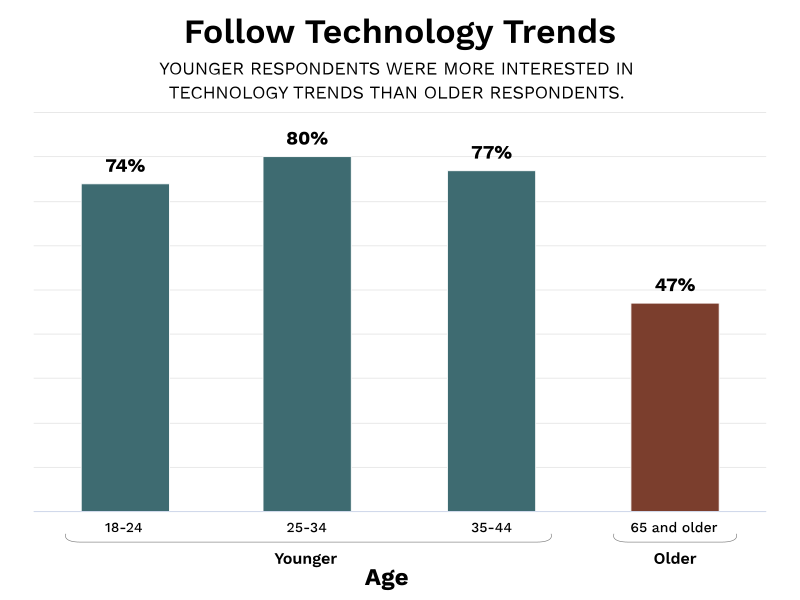
Findings for gender and income show a similar, but less dramatic pattern. Men were more likely to express an interest in following technology trends than women (72% versus 59%) and considered themselves more tech savvy (72% versus 59%). Higher income respondents were also more likely to follow technology trends than lower income respondents (76% versus 61%) and more likely to consider themselves tech savvy (72% versus 61%).
Attitudes Toward Big Tech
Overall, attitudes toward Big Tech were surprisingly positive. First, we asked respondents about their opinion of large technology companies such as Amazon, Apple, Microsoft, Meta, and Google. Nearly three-quarters (73%) of all respondents had positive opinions of large technology companies. Californians and Delawareans were most positive (75% and 75% respectively), with West and East Texans somewhat less so (69% and 73% respectively). Very few respondents expressed negative opinions (6-8%).
Opinions varied more when it came to specific tech companies. Opinions of Amazon and Apple trended more positive. For example, a majority (58%) had positive opinions of Amazon, but only one quarter had negative opinions (26%). Positive opinions of Apple also outnumbered negative ones (45% versus 36%). In contrast, opinions of Alphabet (Google) and Microsoft were largely mixed, with roughly the same percentage expressing positive opinions as negative ones.
Respondents viewed Meta the most negatively among all of the Big Tech companies. Less than one-quarter (22%) of respondents had positive opinions of Meta, while nearly two-thirds (62%) had negative opinions. These negative opinions are not surprising given public criticism the company has faced over the past several years involving disinformation, privacy, the mental health of younger users, and dissatisfaction with its content and advertising practices.
For the most part, attitudinal differences between venues were largely minimal. Californians had the least favorable opinion of Amazon, with only 51% expressing positive opinions compared to other venues (WDTX 61%; EDTX 64%; DDEL 62%). Californians were also the most positive toward Apple, with nearly twice as many expressing positive opinions as negative ones (53% versus 29%). West Texans had the least favorable opinion of Apple, with only 38% expressing positive opinions and 44% expressing negative ones. Notably opinions about Meta did not meaningfully change in the venues studied. Californians, Texans, and Delawareans all had predominantly negative opinions of Meta.
Views of specific Big Tech companies varied most significantly by age. For example, younger people were slightly more positive when it came to Meta (24% age 18-24; 28% age 25-34). While more than two-thirds of those over age 45 had negative opinions of Meta (65% age 45-54; 66% age 55-64; 75% age 65 or older). Respondents with a Bachelor’s or graduate degree were more negative towards Meta and Amazon than those without 4-year college degrees (Meta: 69% vs 59% negative opinions; Amazon: 52% versus 61% positive opinions) and more positive towards Apple (55% versus 40%).
Attitudes Toward Big Tech’s Conduct
While people’s views of Big Tech companies varied somewhat, their views of Big Tech’s conduct did not. Most were critical. For example, while the majority of respondents, regardless of venue, believe large companies are ethical, i.e., 58 – 64%, even more believe they will steal technology from other companies if they think they can get away with it (79%) or if the other company is a small one (75-76%). Most also believe large tech companies are monopolistic and stifle competition (82-90%). Not surprisingly, most believe large tech companies get away with too much because of their size, power, and money (86-89%). What is especially striking is that these beliefs are prevalent among Californians, West Texans, East Texans, and Delawareans.
Also notable is that these beliefs are shared among respondents of different genders, different political persuasions, different educations, and different incomes. Only with respect to age and racial/ethnic affiliation did these opinions vary. For example, the youngest respondents were more likely than the oldest respondents to believe large tech companies are fundamentally ethical (71% age 18-24; 53% age 65 or older). But, younger respondents are also more likely to believe a large tech company would steal from small company (77-81% age 44 or younger; 69% age 65 or older). Additionally, almost three-quarters of African Americans and Hispanics believed large tech companies are ethical (74% and 70% respectively), while only 56% of whites did.
Given respondents’ predominantly negative views of the conduct of large tech companies, it is not surprising that the majority of respondents believe the government should increase its regulation of Big Tech. In fact, the majority of respondents expressed this belief regardless of their state of residence, gender, age, political orientation, education, and income. The only exception to this involved Hispanic respondents where only 49% supported increased regulation of Big Tech. Despite this widespread belief, data showed that Democrats were more likely than Republicans to support increased regulation (62% versus 52%) and those with 4-year degrees were more likely than those without 4-year degrees to support it (64% versus 53%).
Foreign Tech Companies
Foreign tech companies do not fare much better. Seventy-one percent of respondents believe foreign companies that do business in the U.S. are more likely than U.S. companies to disregard U.S. law. Not surprisingly, when asked who was more likely to steal technology, a foreign company or a U.S. company, the majority (55%) stated that foreign companies were. Only 16% believed that U.S. companies were more likely to steal technology. Twenty-nine percent believed that foreign companies and U.S. companies were equally likely to steal U.S. technology.
Notably, these beliefs do not dramatically differ between venues. Nor do they substantially differ between political orientation. Democrats are only somewhat likely as Republicans to believe foreign companies are more likely to disregard U.S. laws (68% versus 76% respectively) and believe foreign companies are more likely than U.S. companies to steal technology (54% versus 61% respectively). These findings suggest the differences between heavily Democratic areas and heavily Republican areas might not be as great as foreign companies might otherwise believe.
In contrast, suspicion toward foreign companies varies more depending on respondents’ other personal characteristics. For example, the belief that foreign companies are more likely than American companies to steal technology is more prevalent among older respondents. The majority of those age 65 or older (58%) believe foreign companies are more likely to steal technology. However, only one-third of those under 45 agree (31% age 18-24; 30% age 25-34; 35% age 35-44). In contrast, younger respondents are more likely than older respondents to believe U.S. tech companies would illegally copy or steal technology. While few over age 55 (9% age 55-64; 4% age 65 or older) believe U.S. companies are more likely to steal technology, this belief is more prevalent among those under age 35 (31% age 18-24; 25% age 25-34).
While whites were more suspicious of foreign companies than African Americans or Hispanics, the difference was relatively modest (41% Whites; 32% African American; 34% Hispanic). African Americans and Hispanics were more suspicious of U.S. companies. Whereas only 13% of whites believed U.S. tech companies were more likely than their foreign counterparts to steal technology, nearly twice as many African Americans and Hispanics did (21% African Americans; 26% Hispanics).
Finally, men were more suspicious toward foreign companies than women. While nearly two-thirds of men (62%) believed foreign companies were more likely than American ones to steal technology, less than half of women were (49%).
Most respondents in all venues believed courts should protect the interests of American tech companies over the interests of foreign tech companies that do business in the U.S. Again, this is not confined to advocates of America First and Maga Republicans. Although Republicans are more likely to advocate this position, Democrats are only slightly less likely to do so (88% versus 80%). A similar pattern is evident between different age groups. Those age 65 and older are more likely to support this viewpoint than 18–24-year-olds (88% versus 75%), but most in each age group believe the courts should protect the interests of American tech companies first.
The impact of this America First philosophy can also be seen in the disparity between those who think the courts should protect American tech companies and those who think they already do. A greater disparity suggests that people think the justice system is not working as it should. This potentially leads to jurors looking to “right this wrong” and do what the courts do not do and take steps to protect the interests of American tech companies in the jury room.
Toward this end, we asked respondents whether they agree or disagree that U.S. courts favor American tech companies over foreign tech companies and identified the disparity between those who think the courts should protect American interests with those who think they already do.
Results show the smallest disparity exists in the Central District of California, suggesting that prospective jurors in this venue are less likely to be influenced by a tech company’s country of origin. Specifically, 79% of Californians believe U.S. courts favor American tech companies and 83% think that they should, producing a 4% disparity. In contrast, the Eastern District of Texas has the highest disparity, suggesting a potential bias favoring American tech companies. While only 71% of East Texans think courts favor American companies, 88% think they should favor American tech companies.
Not surprisingly, this disparity is greater among Republican respondents (16%) than Democrats (2%), older respondents (19% age 55-64; 15% age 65 and older) more so than younger ones (-1% age18-24; -1% age 25-34) and lesser educated respondents (12% for those without 4-year college degrees) when compared to those with more education (1% for those with 4-year college degrees).
These findings suggest that respondents in the Central District of California are a more favorable venue to foreign companies than the Eastern or Western Districts of Texas. However, they also show that personal background can have a bigger impact on the potential for bias than place of residence.
Nevertheless, results show that respondents value the technology and the innovation that foreign tech companies offer. For example, the majority of respondents (59%) believed foreign tech companies make better products than American tech companies. Notably, this belief is held by the majority of Californians, Texans, and Delawareans alike. Data shows, however, this belief is more prevalent among African Americans (69%) and Hispanics (75%) as compared to whites (53%), those without 4-year college degrees (63%) as compared to those with 4-year college degrees (51%), and younger respondents (74% age 18-24; 70% age 25-34) as compared to older respondents (52% age 55-64; 42% age 65 or older).
Many also see foreign companies as being top innovators when it comes to new technologies. We asked respondents to identify countries they consider to be leaders in innovation from a list that included North American, Asian, and European countries. Not surprisingly roughly two-thirds of respondents chose the United States as a top innovator. Interestingly, nearly the same amount identified China as a leader in innovation. In fact, the majority of respondents, regardless of venue, age, race, gender, education, income, and political affiliation named the U.S. and China as leaders in innovation. The only other country to be identified by a majority was Japan (52%). However, only the majority of Californians and West Texans identified Japan as a top innovator (55% and 52% respectively). Less than half of East Texans and Delawareans did (48% and 49% respectively).
Patent Validity
Challenging a patent’s validity is always a focus for defendants facing infringement claims, despite the fact that few juries ever render a patent invalid. Most jurors are simply too reluctant to contradict the work of patent examiners when it comes to advanced technology. To shed light on who might be more willing to invalidate a patent we examined attitudes centering on the competence of government examiners in awarding patents.
We asked respondents how likely it is for government experts to make a serious mistake when evaluating whether a piece of new technology deserves a patent. Responses ranged from “very likely” to “not likely at all.” For the purposes of this analysis, we compared those who believed it was “very likely” the government examiner could make a serious mistake with all others.
Overall, analyses show that East and West Texans are more likely to think serious mistakes are very likely. Thirty-seven percent of East Texans believed that serious mistakes were very likely. Only one-quarter of Californians and 21% of Delawareans shared these beliefs. Additionally, Republicans are more likely than Democrats to think serious mistakes are very likely (29% versus 23%) and higher than average earners are more likely than lower than average earners to think serious mistakes are very likely (30% versus 23%). As these results demonstrate, however, the vast majority of respondents think that serious mistakes are not commonplace.
In the 2020 survey, we analyzed different subpopulations within each venue to identify any subpopulation where the majority distrusted the government only to issue patents when they are truly deserved. Analyses revealed that in the Northern District of California the majority of young men did not trust the government to only issue patents when they were deserved. These results indicated this group would be the most receptive to invalidity arguments.
We conducted the same analyses here but focused on perceptions that serious mistakes were very likely. And indeed, we identified subpopulations in which the majority believed serious mistakes were very likely. Specifically, we found the majority of more educated (59%) and higher income (54%) respondents in the Marshall Division thought serious mistakes were very likely. Although the EDTX sample was relatively small (n=107), the potential impact of this finding outweighed its limitations. In short, this data suggests that higher educated and higher income respondents in the Marshall Division will be the most receptive to invalidity arguments.
Highly Paid Experts
Intellectual property disputes are often won or lost on the backs of expert witnesses, especially for cases that focus on the details of the technology at issue. Finding the right expert can be exceptionally challenging. In the survey, we examined public attitudes that pertain to two aspects of expert selection, the type of expert and cost. First, we asked respondents if they had to learn about advanced technology, who they would most like to hear from. Option A was a retired executive from a tech company who has experience with the technology but does not have a Ph.D. Option B was a college professor with a Ph.D. who has studied the technology but does not have significant experience in the industry. Results showed that most respondents, regardless of venue, preferred to learn about advanced technology from a retired executive rather than a college professor (73%-79%).
While there was some difference between Republicans and Democrats (83% of Republicans preferred executives versus 74% of Democrats) and the oldest and youngest respondents (87% of those 65 or older preferred executives versus 63% for those age 18-24), most favored a retired executive over a college professor.
However, depending on the industry, retired executive experts can charge significantly more—or less—than college professors. As a result, we also inquired about how respondents viewed expert pay. To assess higher pay, we presented respondents with the following scenario.
In a lawsuit between two companies, both sides hire experts. One side hires John Smith, Ph.D. who is paid $1,000 per hour, while the other side hires Patrick Jones, Ph.D. who is paid $300 per hour.
We then asked respondents which of the following three options best reflected their first impression about the relative pay of these experts.
1. Smith is more qualified and commands higher pay
2. Smith’s high pay makes his opinion suspect
3. Their pay difference is irrelevant
Results showed that most respondents, regardless of venue, did not view higher pay negatively. About half viewed it as irrelevant and another one-quarter to one-third viewed it positively. East Texans were least likely to view it positively as compared to Californians, who were the most likely to view it positively (23% versus 33% respectively). Notably, in each venue, more respondents viewed higher pay as demonstrating higher qualifications than viewed it as suspect.
Higher income respondents were twice as likely to view higher pay positively than negatively (37% versus 18%). Hispanics showed a similar pattern (39% versus 19%) Additionally, younger respondents were more likely to view higher pay positively than older respondents. In fact, those under age 35 were more likely to view it positively than as irrelevant (19-24: 43% positively versus 30% irrelevant; 25-34: 44% view positively versus 34% view as irrelevant). In contrast, older respondents were more likely to view higher pay negatively than positively (55-65: 23% view negatively versus 19% view positively; 65 or older: 24% view negatively versus 15% view positively), even though a majority of both age groups believed pay was irrelevant.
Non-Practicing Entities
Because a significant number of infringement claims are brought by non-practicing entities, we asked respondents about their perceptions of NPEs. Because NPEs are not widely known, we prefaced the question with an explanation of NPEs.[2] We then presented them with two competing views of NPEs and asked respondents to choose the one they believed was most likely true. The first was: These companies stand in the shoes of the little guy and sue large companies who steal technology from those who lack the resources to fund lawsuits. The second built upon their characterization as patent trolls: These companies are leeches in the business of filing frivolous lawsuits, clog up the legal system, and make technology more expensive for everyone.
Results showed that respondents were largely evenly split regardless of the venue, with roughly half describing them as doing good and half describing them as leeches. Only different age groups viewed them differently. Older respondents were more likely to see them as leeches and younger respondents were more likely to see them as doing good. Fifty-nine percent of those age 55-64 and 66% of those age 65 or older viewed NPEs as leeches, while 55% of 18-24 year olds, 58% of 25-34 year olds, and 59% of those 35-44 saw them as doing good.
Key Takeaways & Recommendations
As in DOAR’s 2020 survey, we found that different venues shared many similarities in public attitudes related to IP litigation. For example, in this 2024 survey we found the majority of respondents in Central District of California, the Waco Division of the Western District of Texas, the Marshall Division of the Eastern District of Texas, and the District of Delaware expressed the following:
- Positive views about large technology companies, but concerns about some of their conduct
- The belief that foreign tech companies make better products than American tech companies
- The belief that foreign tech companies that do business in the U.S. are more likely than American tech companies to disregard U.S. law
- A preference for industry experts rather than academics
- No problems with highly paid experts
Despite these shared beliefs, there were some differences between venues. Like we found in 2020, Delaware residents tended to look more favorably on large corporations. Not only did a greater percentage express positive opinions of large technology companies but more believed that large tech companies were ethical. Additionally, they were the least likely to think foreign tech companies make better products and the least likely to think American tech companies would illegally copy or steal technology—although these differences were minimal. Nevertheless, Delawareans continue to exhibit favoritism to Big Tech.
West Texas residents, just like in the 2020 survey, exhibited suspicion toward foreign companies, although less so than was found in the prior survey. Nevertheless, the majority believe foreign companies are more likely to illegally copy or steal technology. Most also believe the court system should protect the interests of American tech companies over their foreign counterparts—however, this belief was shared by most in other venues as well. In short, the data suggest that foreign tech companies litigating disputes in this venue will find it a challenging one.
East Texas residents, in contrast, were less suspicious of foreign companies but were more committed to the idea that the courts should protect the interests of American tech companies over their foreign counterparts. East Texas residents were the least likely among all the venues surveyed to believe the foreign companies would illegally copy or steal technology. They were also the most likely to believe that courts should protect the interests of American tech companies over foreign tech companies. Moreover, East Texans believed the courts were falling short of this goal—indicating that prospective jurors in this venue were prone favor American tech companies. Thus, data suggests foreign tech companies would confront a similar set of challenges in Marshall as they would in Waco.
Interestingly, Californians tended to express concerns about both large corporations and foreign corporations. To begin, Californians were the most interested in technology and the most tech savvy. Californians also had the most positive opinions of large corporations, tying Delaware in this regard but paradoxically were the least likely to believe they were ethical. They were also the most likely to favor increased regulation of Big Tech. Notably, Californians were also quite suspicious of foreign tech companies. Californians were more likely than Texans to believe foreign tech companies would illegally copy or steal technology. Nevertheless, data also suggest that Californians are less likely to favor American tech companies over foreign tech companies in litigation.
For NPE plaintiffs, results were mixed in each venue, neither predominantly negative nor positive. For defendants challenging the validity of patents, results suggest doubts about patent examiner competence are also largely mixed, with Texans expressing the most doubts. However, in the Marshall division two specific groups expressed more doubt than any others, namely more educated and higher income respondents—the majority of which believed serious mistakes were very likely when applications are reviewed. Among all of the different groups surveyed, these are the ones that will be the most receptive to invalidity arguments.
Key Attitudinal Differences
- Most tech savvy
- Least likely to believe large tech corporations are ethical
- Most likely to favor increased regulation of Big Tech
- More Suspicious of foreign companies
- The majority believe foreign companies are more likely to illegally copy or steal technology
- More committed to the idea that the courts should protect the interests of American tech companies over their foreign counterparts
- Favor Big Tech
- Least likely to think foreign tech companies make better products
- More believe large tech companies are ethical
Even with these venue differences, data show that venue differences pale in comparison to sociodemographic ones. For example, older respondents were much less tech savvy, displayed far less interest in technological trends, and were generally more critical of Big Tech. They also demonstrated the most bias against foreign tech companies. Unlike most other respondents, older respondents were more likely to believe American tech companies made better products than their foreign counterparts. Older respondents were also most likely to believe U.S. courts should protect the interests of American tech companies. These data suggest that older prospective jurors, regardless of the venue, will be especially risky for foreign companies litigating disputes in this country.
The data also shows consistent, but not as strong, effects when it comes to political orientation. Republicans tended to be more suspicious of foreign companies and favor American tech companies. Republicans were more likely to believe foreign companies would disregard U.S. laws and illegally copy or steal U.S. technology. They were also more likely to believe the courts should protect the interests of American tech companies over their foreign counterparts and demonstrated a greater likelihood of acting in furtherance of that goal.
In the end, the survey shows different venues carry different risks but that these risks pale in comparison to the risks posed by certain sociodemographic groups. These findings underscore the importance of jury selection strategy when litigating IP disputes in any of these venues. While this study sheds light on who might be more or less risky, anyone who has picked a jury in these venues knows that the facts of any particular case can turn a stereotypical juror profile on its head. Only by testing these facts in front of mock juries can litigants properly assess whether the particular facts of a case confirm or upend expectations about good and bad jurors.
[1]As is common in market research databases, Hispanics were underrepresented in each venue. Additionally, the CDCA sample included more degreed respondents than are present in the venue, i.e., roughly 41% versus 30%). Also, the EDTX sample included significantly more women than men, roughly 68% of the 107 respondents were women. Given the paucity of empirical research conducted in the Marshal Division after Judge Gilstrap issued his standing order, we decided to obtain the largest sample size possible. Each of these issues was factored into the analysis, the interpretation of results and conclusions.
[2] The question was prefaced with the following: Today, some companies are in the business of buying patent rights. These companies do not make or sell any kind of product. Instead, they purchase the patent rights from inventors in order to file lawsuits against those who they claim infringe those patents. Some claim that these companies stand in the shoes of inventors and sue large companies who steal technology from the little guy, individual inventors and small businesses who could not otherwise afford to sue. Others say these companies, which they refer to as patent trolls, are like leeches who are in the business of frivolous lawsuits, clog up the courts with frivolous lawsuits, pressure legitimate companies to settle and increase the cost of technology for everyone.


The DOAR Research Center found that jurors’ occupations strongly influence how they view technology companies and intellectual property disputes.

Following the 2024 presidential election, the DOAR Research Center conducted a national survey revealing a shift in how jurors view white-collar cases.

The DOAR Research Center conducted a national study to understand how jurors evaluate trade secret disputes in today’s workplace environment.

The DOAR Research Center examined how jurors respond to free speech arguments amid growing polarization and debate over the First Amendment.

Amid growing concern over drug pricing and the opioid crisis, the DOAR Research Center studied public attitudes toward pharmaceutical companies.

The DOAR Research Center examined how jurors approach workplace harassment and discrimination claims in the post-#MeToo era.