
Introduction
When the First Amendment was ratified in the Constitution over 200 years ago, the purpose was to prevent the government from enacting laws that would restrict free speech and other individual liberties—in essence, to prevent government overreach. Since then, for some, the First Amendment has become mythologized into the right to say whatever you want without consequences. This has also coincided with a shift from the First Amendment as a more progressive liberal agenda, protecting minority viewpoints and supporting various social movements such as civil rights and LGBTQ rights, among others, to a more conservative one that believes political correctness has gone too far. Then in 2016 with the election of Donald J. Trump as President and the ushering in of the MAGA movement, MAGA supporters have become some of the staunchest advocates of free speech. They believe their views are underrepresented and unfairly criticized in the media and are concerned about censorship and policies that would limit their ability to speak freely online. However, advocates of the First Amendment are not confined to particular political groups. A 2024 poll from the Cato Institute reported that 74% of Americans say free speech is extremely important to them personally.
74% of Americans say free speech is extremely important to them personally.
69% of Americans believe the country is on the wrong track on free speech.
57% of Americans agree that protestors have the right to protest against a particular racial/ethnic group because of First Amendment protections.
But political rhetoric in the U.S. has intensified. Political polarization is probably more extreme now than it has been since the Civil War. Social media platforms serve as echo chambers that exacerbate political divides. The anonymity of posting comments online has emboldened people to express aggressive and violent sentiments. Social activism has become more brazen as well. Protests conducted without restraint are becoming increasingly ubiquitous (e.g., George Floyd and Black Lives Matter, college protests over the war in Gaza). This is partially due to the rise of social media, which has allowed activists to mobilize on a larger scale and without traditional checks or balances.
The weaponization of free speech has also caused the lines between what is right and what is wrong to become blurred. We saw this in 2020 when Donald J. Trump claimed the presidential election had been stolen. Other countries have similarly seen claims of stolen elections—most recently in 2022 with former President of Brazil, Jair Bolsonaro. And disinformation campaigns have led to instances of election interference, as with Russia’s interference in the 2016 U.S. presidential election.
It is fair to say the current zeitgeist is characterized by uncertainty surrounding the nature and boundaries of free speech. This begs the question of how free speech arguments play in the courtroom. Arguments have become more common in a number of different types of cases, including defamation, copyright infringement and social media regulation. Not surprisingly, the success of these arguments has been mixed.
We suspect that this divergence in general attitudes towards free speech and support for free speech arguments in specific cases stems from people only caring about the First Amendment when it applies to them—when it is their speech, rather than someone else’s, that is at issue—or when their experiences make them more likely to identify with the those that are being deprived of their right to free speech, as in the case of minority group members or MAGA supporters.
Despite the rulings made by judges, questions arise on how jurors respond to First Amendment and free speech arguments. In July 2024, the DOAR Research Center conducted an online survey to address these questions. In this survey, we questioned respondents about their views of first amendment arguments made in a hypothetical defamation case, copyright infringement case and a case involving social media regulation. Jury eligible residents of the Southern District of New York and Eastern District of New York participated in the survey. We selected these venues because the New York courts and SDNY especially has tried many of these high-profile cases where free speech arguments are being advanced.
Key Findings
Part I: Opinions and Experiences Surrounding Free Speech
In line with recent polls, the vast majority (98%) of New Yorkers think free speech is essential to being an American, and a slight majority (55%) think preserving free speech is more important than preventing hate speech.
Forty percent of respondents think that political correctness has gone too far, 31% think it’s appropriate, and 11% say it has not gone far enough.
Most respondents (56%) feel they are to some extent deprived of their right to free speech: 43% say they are deprived of their right to free speech on occasion and 13% say they are deprived of this right all the time.
Most respondents (71%) say they have not voiced an unpopular opinion because they have felt concern about being punished or penalized for doing so, yet over half (55%) say they have never been penalized for voicing their opinion. This indicates more people have a fear of being punished or penalized than is warranted. Indeed, the majority (57%) of those who have never been penalized for voicing an opinion reported not having voiced an opinion out of concern about being punished or penalized.
Predictors of Opinions and Experiences Surrounding Free Speech
To get a sense for what types of people might be more receptive to free speech arguments in legal cases, we examined characteristics of respondents who were more likely to prioritize free speech over preventing hate speech. (See Appendix for comparison groups used throughout the survey.)
Not surprisingly, this profile overlaps with the typical MAGA profile. MAGA supporters are known for being distrusting of institutions, including the mainstream media and government, have conservative values, and are often White/Caucasian and working-class. Given these characteristics were also identifiable in our survey, we created a composite variable to identify MAGA supporters as those who only watch right wing news media, have no trust in the federal government, and have no trust in news media. However, because of increased media attention to non-White members of the MAGA movement, we also distinguished between White and non-White MAGA supporters. Among MAGA supporters, 65% (n = 41) were White/Caucasian, and 35% (n = 22) were non-White. While these are small sub-samples, we wanted to see how White MAGA supporters behave similarly or differently from non-White MAGA supporters. As expected, 81% of White MAGA supporters think political correctness “goes too far.” Only 55% of non-White MAGA supporters feel the same way.
-
- Male***
- Conservative***
- Republican***
- Watches only right-wing news media**
- Posts comments on social media platforms*
- Has no trust in the federal government***
- Has no trust in the news media***
Statistical significance:
One asterisk indicates p less than 0.05,
two asterisks indicates p less than 0.01,
three asterisks indicates p less than 0.001
We were also interested in characteristics of those who have felt deprived of their right to free speech, those who have felt they could not voice an unpopular opinion due to concern about being penalized or punished for doing so, and those who have been penalized for voicing their opinion. Several patterns emerged from this analysis.
Predictors of Those Who Have Felt Deprived of Their Right to Free Speech
First, those who were more likely to report feeling deprived of their right to free speech were: younger, male, Conservative, Republican, Catholic or Christian, post comments on social media, and have no trust in the federal government, courts, or news media. We again see the typical MAGA profile. Indeed, 81% of White MAGA supporters and 68% of non-White MAGA supporters have felt deprived of their right to free speech.
Notably, among those who post comments on social media platforms, African Americans/Blacks, Hispanic/Latinx, and MENA (Middle East and North Africa), Puerto Rican, Native American, Indian, Filipino, and Mixed/Bi-Racial respondents were more likely than White/Caucasian respondents to feel deprived of their right to free speech. This suggests that non-Whites may identify with MAGA in some respects and use posting online as a means of being heard. Indeed, 63% of respondents who post comments online say they have felt deprived of their right to free speech compared to only 41% of those who never post comments online (p < .001). Given the relative anonymity of posting comments online, it makes sense that this would be a forum for individuals who have felt deprived of their right to free speech. Additionally, while people who post comments online were more likely than their counterparts who do not post online to report feeling deprived of their right to free speech, we also found that people under the age of 45 were more likely to post online than those 45 or older. Specifically, 80% of those under the age of 45 and 62% of those 45 and older post comments online (p < .001).
-
- Under 45 years old***
- Male**
- Conservative***
- Republican***
- Religious***, specifically:
- Muslim**
- Catholic or Christian**
- No trust in the federal government***
- No trust in the courts***
- No trust in the news media***
- Primarily worked blue-collar jobs***
- Posts comments on social media platforms***
- Nonwhites***, specifically:
- African American or Black***, especially if:
- No college degree***
- Hispanic or Latinx***, especially if:
- Republican**
- MENA, Puerto Rican, Native American, Indian, Filipino, and Mixed/Bi-racial**
- African American or Black***, especially if:
Statistical significance:
One asterisk indicates p less than 0.05,
two asterisks indicates p less than 0.01,
three asterisks indicates p less than 0.001
We also see that historically disenfranchised groups such as non-whites, religious minorities, and those who are younger and less educated were more likely to say they have felt deprived of their right to free speech. African American or Black, Hispanic or Latinx, MENA, Puerto Rican, Native American, Indian, Filipino, and Mixed/Bi-Racial respondents were all more likely than White/ Caucasian respondents to feel deprived of their right to free speech. Among African American/Black respondents, education and job type were especially notable: those without college degrees and who have primarily worked blue-collar jobs (i.e., construction, manufacturing, or agriculture) were more likely to feel deprived of their right to free speech. Job type (i.e., having worked primarily blue-collar vs. white-collar jobs) was also meaningful among those who identify as MENA, Puerto Rican, Native American, Indian, Filipino, and Mixed/Bi-racial, with blue-collar workers being more likely to report feeling deprived, though the sample size was small.
Additionally, Hispanic/Latinx respondents that were Republican were more likely than White/Caucasian Republicans and Hispanic/Latinx Democrats to report feeling deprived.
Similar patterns arose among those who have not voiced an unpopular opinion out of concern about the repercussions or have been penalized for voicing their opinion. Those profiles are provided in the following section.
Predictors of Those Who Have Not Voiced An Unpopular Opinion Due to Concerns About Repercussions
- Under 45 years old***
- Posts comments on social media platforms***
- Republican*, especially if:
- Hispanic or Latinx*
- Higher income ($100K or more)***, especially if:
- Male***
Statistical significance:
One asterisk indicates p less than 0.05,
two asterisks indicates p less than 0.01,
three asterisks indicates p less than 0.001
Of note in this category is that males with higher personal incomes (i.e., $100K or more per year) were more likely than males with lower incomes (i.e., less than $100K) to say they have not voiced an unpopular opinion out of concern about being punished or penalized for doing so. There was no difference for women based on whether they were higher or lower income earners. It may be that higher income males, despite being close enough to the top to be heard, feel that they would lose what power or authority they have gained if they were to speak up.
Predictors of Those Who Have Been Penalized for Voicing Their Opinion
Respondents who are African American/Black and Republican were also more likely than Caucasian/White Republicans to say they have been penalized for voicing their opinion, though there were few African American/Black respondents who identified as Republican (n = 38). Those who identify as MENA, Puerto Rican, Native American, Indian, Filipino, or Mixed/Bi-racial who post comments online were more likely than Caucasians/Whites who post comments online to report having been penalized for voicing their opinion. The same pattern emerged for Hispanic/Latinx and African American/Black respondents when compared to Caucasian/White respondents, but the differences were not as large or statistically significant. These results suggest some important differences between White and non-White MAGA supporters.
Notably, 68% of White MAGA supporters and 64% of non-White MAGA supporters said they had not voiced an unpopular opinion due to concern about being penalized or punished for doing so, yet only 54% of White MAGA supporters and 46% of non-White MAGA supporters reported being penalized for voicing their opinion. This again suggests a mismatch between the fear of punishment and likelihood of punishment actually resulting from voicing their opinions.
- Under 45 years old***
- Male***
- Conservative***
- Republican*
- Posts comments on social media platforms***
- Primarily worked blue-collar jobs***
- Muslim*
- African American or Black**, especially if:
- Male**
- Republican*
- MENA, Puerto Rican, Native American, Indian,
- Filipino, and Mixed/Bi-racial** especially if:
- Posts comments on social media platforms**
Statistical significance:
One asterisk indicates p less than 0.05,
two asterisks indicates p less than 0.01,
three asterisks indicates p less than 0.001
Part II: Trust in the Federal Government, Courts, and News Media
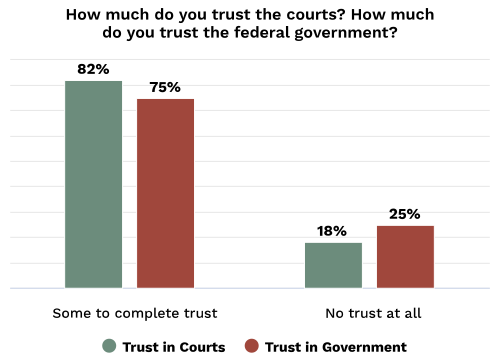
Most respondents (82%) say they have some to complete trust in the courts; most (75%) say they have some to complete trust in the federal government; and most (71%) say they have some to complete trust in the news media.
- Thinks preventing hate speech is more important than preserving free speech***
- Liberal***
- Democrat***
- Only watches left-wing news media***
- College graduate***
Statistical significance: One asterisk indicates p less than 0.05, two asterisks indicates p less than 0.01, three asterisks indicates p less than 0.001
- Thinks hate speech more important than preserving free speech***
- Liberal***
- Democrat***
- Only watches left-wing news media***
- College graduate ***
- Lives in an urban area**
Statistical significance: One asterisk indicates p less than 0.05, two asterisks indicates p less than 0.01, three asterisks indicates p less than 0.001
- Only watches left-wing news media***
- College graduate ***
- Higher income (100K or more)**
Statistical significance: One asterisk indicates p less than 0.05, two asterisks indicates p less than 0.01, three asterisks indicates p less than 0.001
Part III: Decision-Making in Hypothetical Legal Cases Involving Free Speech Arguments
We asked respondents which party they would be more likely to side with in three hypothetical legal cases involving free speech arguments: copyright infringement, online posting in violation of company policies, and defamation. To test our hypothesis that people care more about free speech when it applies to their own speech rather than someone else’s speech, in two of the scenarios (copyright infringement and online posting) we varied whether respondents were asked to imagine that the party advocating free speech was a stranger or a loved one. We expected that respondents would be more likely to support the free speech position when the party advancing that position was a loved one. In the third scenario (defamation), we tested how people view a company making a free speech argument because it may be harder to think of a company advancing an individual right to free speech. In that scenario, we varied whether the other party (the individual) was described as a stranger or loved one.
Copyright Infringement Scenario
In the first scenario, we asked respondents to imagine that someone (a stranger or a loved one) creates a digital representation of a Barbie doll and calls it art. The digital representation exists in two dimensions and is not itself a Barbie doll. The owner of Barbie, Mattel, discovers this and sues the artist for copyright infringement. We asked respondents with which side of the case they would be most likely to agree: the plaintiff, Mattel, because the artist is infringing on the company’s copyrighted product, or the defendant-artist because the digital representation is an act of artistic expression that is protected under the First Amendment.
Overall, more respondents sided with the plaintiff-company alleging there had been a copyright violation than the defendant-artist arguing first amendment protection (60% and 40%, respectively). This was true regardless of whether the artist was described as a stranger or loved one: 64% of those who heard the artist was a stranger and 57% of those who heard the artist was a loved one sided with the plaintiff-company. The difference between these two groups, however, was meaningful: In support of our hypothesis, when respondents were asked to imagine the artist was a loved one (vs. a stranger), they were statistically significantly more likely to side with the defendant-artist advocating free speech (43% vs. 36%, respectively**).
We examined characteristics of those more likely to agree with the plaintiff-company arguing copyright infringement and characteristics of those more likely to agree with the defendant-artist arguing First Amendment protection. Respondents that were more likely to agree with the defendant had never worked outside the home, especially if they were also Hispanic/Latinx or African American/Black or if they post comments on social media platforms. Interestingly, of the 17 Hispanic/Latinx respondents who have never worked outside the home, 14 (82%) sided with the defendant-artist; of the 17 African American/Black respondents who have never worked outside the home, 12 (71%) sided with the defendant-artist; of the 44 respondents who post comments on social media and have never worked outside the home, 31 (71%) sided with the defendant-artist. This suggests a profile of people who are typically suspicious of large corporations (likely because they have never worked at one) and do not trust institutions to advocate for them or their needs.
On the other hand, respondents who were more likely to side with the plaintiff-company alleging copyright infringement had characteristics suggesting they would be more likely to identify with Mattel or the executives of a large corporation or have a desire to defend large corporations. These are people who have mostly worked at large corporations, have primarily worked white-collar jobs (i.e., media/journalism, business, legal, and engineering), are religious, older, live in a suburban area, and are Caucasian or White.
- Never worked outside the home***, especially if:
- Hispanic or Latinx
- African American or Black
- Posts comments on social media platforms
Statistical significance: One asterisk indicates p less than 0.05, two asterisks indicates p less than 0.01, three asterisks indicates p less than 0.001
- Mostly worked for large corporations***
- Primarily worked in jobs considered white-collar**
- Religious**
- Lives in a suburban area*
- 45 years or older***
- Caucasian or White***, especially if:
- 45 years or older***
- Lives in a suburban area*
- Conservative*
- Republican*
Statistical significance: One asterisk indicates p less than 0.05, two asterisks indicates p less than 0.01, three asterisks indicates p less than 0.001
Online Posting Scenario
In the next scenario, we told respondents to imagine that another person or a loved one had their X/Twitter account suspended for political comments they made on the platform. We then asked if they would be more likely to agree with X/Twitter for suspending the user’s account because the statements violated the company’s policies against content that could be perceived as threatening or inciting violence, or if they would be more likely to say that X/Twitter should not be able to suspend that person’s account because he or she has the right to freedom of speech under the First Amendment.
Overall, more respondents agreed that X/Twitter had the right to suspend the user’s account in violation of company policies than they were to say the account should not have been suspended because of First Amendment protections (59% and 41%, respectively). As in the copyright infringement scenario, this was true regardless of whether the user was a stranger or a loved one: 62% of those who heard the user was a stranger and 55% of those who heard the user was a loved one sided with X/Twitter. Again, however, in support of our hypothesis, those who were told the user was a loved one were more likely to agree that X/Twitter should not have suspended the account in support of the free speech argument than those who were told the user was just some other person (45% and 38%, respectively**).
The profile of those more likely to go against X/Twitter and advocate for free speech protections could generally be described as MAGA supporters: Republican, watches right-wing news media, would vote for Trump in the 2024 election, believes preserving free speech is more important than preventing hate speech, and has no trust in the federal government or news media. We also see the same pattern of marginalized groups (i.e., younger respondents who are Hispanic/Latinx, not college educated, or have never worked outside the home) being more likely to agree with the free speech position.
On the other side, for those who were more likely to agree with X/Twitter’s decision to suspend the user’s accounts, we see the opposite profile: Liberals, Democrats, believe preventing hate speech is more important than preserving free speech, Caucasians or Whites that are college graduates and from an urban area as well as people over the age of 45 who are not religious. This is the profile of a more privileged group, as evidenced by the fact that these were respondents who were more likely to say they have never felt deprived of their right to free speech, have never felt they could NOT voice an unpopular opinion out of fear of punishment, have never been penalized for voicing an opinion, and do not post comments on social media.
- Believe preserving free speech is more important than preventing hate speech***
- Republican***
- Would vote for Trump in the 2024 election***
- Watches only right-wing media***
- No trust in federal government***
- No trust in news media***
- Hispanic/Latinx***, especially if:
- Under 45 years old*
- Republican***
- Under 45 years of age if:
- Not college educated***
- Never worked outside the home***
- Believe preventing hate speech is more important than preserving free speech***
- Believe political correctness is appropriate***
- Never felt deprived of their right to free speech***
- Never NOT voiced an unpopular opinion due to concern about being punished or penalized for it***
- Never been penalized for not voicing an opinion***
- Never posts comments on social media platforms**
- Liberal***
- Democrat**
- Some or more trust in the courts*
- Caucasian or White***, especially if:
- College graduate***
- From an urban area*
- 45 years or older***, especially if:
- Not religious, i.e., atheist or agnostic*
Defamation Scenario
Finally, we presented respondents with a scenario in which a company fires an employee, who they were told to imagine was either a stranger or a loved one, amid multiple allegations of sexual harassment against him or her. After the person is fired, the company puts out a public statement that the employee had “grossly violated” the company’s standards and values and the employee is now suing the company for defamation. We asked respondents two questions. The first was whether they would be more likely to side with the plaintiff-employee or the defendant-company.
Based on this information—that is, without being told explicitly to think about the defendant’s position in the context of free speech—respondents slightly favored the plaintiff-employee over the company (53% vs 47%, respectively). Notably, however, results changed dramatically based on whether respondents imagined the employee was a stranger or a loved one. Among respondents who imagined the employee was a stranger, 55% voted for the defendant-company and 45% voted for the plaintiff-employee (p < .001). The pattern reversed for those told to imagine the employee was a loved one: 39% sided with the defendant-company and 61% sided with the plaintiff-employee (p < .001). In other words, absent thinking about the plaintiff as a close other, respondents would have been more likely to side with the defendant-company. Imagining the plaintiff as a loved one made the plaintiff’s position more favorable.
The profile of those more likely to side with the plaintiff-employee suggests people who would be more likely to identify with the plaintiff who has been fired in this scenario—someone who is more likely to be at risk of or concerned about something similar happening to them at work or has in fact been in a similar situation already. Those more likely to side with the plaintiff-employee were: male, religious, conservative, Republican, would vote for Trump in the 2024 election, work blue-collar jobs, posts comments online, feel deprived of their right to free speech, feel they are penalized for voicing their opinion “all the time,” feel they cannot voice an unpopular opinion due to concern about punishment for doing so, and have no trust in the courts.
Those more likely to side with the defendant-company were again on the opposite side of the political spectrum (i.e., liberal), not religious, and have primarily worked in law enforcement or for the government.
After respondents answered this first question about which side they would be more likely to favor, we told them that it turns out the sexual harassment allegations against the employee were false. We then presented them with a second question: Do you think the company was entitled to make those statements because it was exercising its First Amendment right to free speech? Respondents were given four response options: definitely yes, probably yes, probably no, and definitely no.
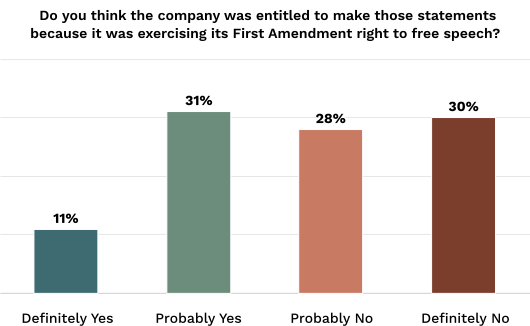
Most respondents (58%) said no, the company was not entitled to make those statements: 28% said “probably no” and 30% said “definitely no”. Notably, among those asked to imagine the plaintiff-employee was a loved one (vs. a stranger), a greater proportion said “definitely no” (35% and 26%, respectively). This makes intuitive sense—if a company has harmed someone you care about, you are going to be more likely to say the company was out of line.
Respondents who were more likely to say the company still had the right to make those statements about the employee because of First Amendment protection were more likely to say they feel they are deprived of their right to free speech and that they are penalized for voicing their opinion “all the time.” It is understandable, then, that even in the face of evidence demonstrating the company had made patently false or unfounded statements, these are individuals who would still defend free speech.
Respondents who were more likely to say no, the company did not have the right to make those statements were a generally more privileged group: people who have never been penalized for voicing their opinion, have never NOT voiced an unpopular opinion because of concern about punishment, believe preventing hate speech is more important than preserving free speech, older, and live in a suburban area. We also see Whites or Caucasians that are less educated, female, and lower income being more likely to say the company did not have the right to make those statements. This is a group that likely distrusts large corporations.
- Male**
- Religious***
- Conservative**
- Republican*
- Would vote for Trump in the 2024 election*
- Posts comments on social media platforms, especially if does so often**
- Feels that they are deprived of their right to free speech ***
- Feels that they are penalized for voicing their opinion “all the time”***
- Feels that they cannot voice an unpopular because of concern about being punished or penalized “all they time”**
- Primarily worked blue-collar jobs**
- No trust in the courts**
Statistical significance: One asterisk indicates p less than 0.05, two asterisks indicates p less than 0.01, three asterisks indicates p less than 0.001
- Liberal***
- Not religious, i.e., atheist or agnostic***
- Primarily worked in law enforcement or for the government*
Statistical significance: One asterisk indicates p less than 0.05, two asterisks indicates p less than 0.01, three asterisks indicates p less than 0.001
- Feels that they are deprived of their right to free speech***
- Feels that they are penalized for voicing an opinion “all the time”***
Statistical significance: One asterisk indicates p less than 0.05, two asterisks indicates p less than 0.01, three asterisks indicates p less than 0.001
- Never felt deprived of their right to free speech***
- Never been penalized for voicing an opinion**
- Never NOT voiced an unpopular opinion due to concern about being punished or penalized for it*
- Believe preventing hate speech is more important than preserving free speech*
- Live in a suburban area***
- 45 years or older***
- Caucasian or White if:
- Not a college graduate***
- Female**
- Lower income (less than $100K)*
Statistical significance: One asterisk indicates p less than 0.05, two asterisks indicates p less than 0.01, three asterisks indicates p less than 0.001
Key Takeaways & Recommendations
The Balance Between Protecting Free Speech and Preventing Hate Speech
Our results reveal that people who value free speech emphasize protecting free speech over preventing hate speech, feel they have been deprived of their right to free speech, are concerned about being penalized for voicing an unpopular opinion and have been penalized for voicing their opinions. Our results also shed light on what types of people are likely to feel this way. They have no trust in the federal government or news media, post comments on social media platforms, watch only right-wing news media, are Conservative and/or Republican, younger, male, a member of racial/ethnic minority, and never worked outside the home. In other words, MAGA supporters and people whose rights have been deprived or whose voices are being suppressed. Posting online seems to be an especially strong indicator of people who prioritize free speech as it seems to serve as a forum for people looking to be heard and express their anger or frustrations.
On the other side, people who are less receptive to free speech arguments are those who historically have been advocates of free speech but now feel the First Amendment is being misused to cause harm. They value preventing hate speech over protecting free speech and have never felt deprived of the right to free speech, never felt concerned about voicing their opinions, and never been penalized for voicing their opinions. This is a more privileged group that our results indicate are more likely to be Liberal and/or Democrat, college educated, and not religious (i.e., atheist or agnostic).
Americans More Likely to Support Free Speech Arguments When It Relates to Them
One of the more interesting and validating findings from our research is the powerful effect of humanizing parties in a case. By making the party advocating for free speech someone you can imagine caring for, people on both sides of the aisle were more likely to side with their position. This is certainly more challenging in court where attempts to humanize a plaintiff or defendant are often countervailed by damaging information. Jurors may also see those personal details as irrelevant, which can backfire and further distance your client from the jury. This highlights the importance of making your client relatable and doing so without overselling. It is better to weave humanizing components throughout your case than it is to make them a standalone feature such as an introduction. But while one side is concerned with making the client relatable, the other side is more concerned with identifying jurors during jury selection who are going to identify with your client so they can remove them.
Juror Perceptions and Experiences Related to Free Speech Critical to Jury Selection
Americans’ interpretation of free speech has evolved since the First Amendment was incorporated into our Constitution. People who were once free speech advocates are now critical of those advocating for free speech. The First Amendment has been co-opted for various agendas. But the courts remain wary. And despite widespread support for the First Amendment and free speech in general, jurors are likely to be skeptical of these arguments. In each of our hypothetical scenarios—copyright infringement, defamation, and social media regulation—most respondents went against the party arguing for free speech.
Importantly, we also know what defines people in that minority who would be more inclined to support free speech arguments. This group falls into two buckets: those who want rights they have been deprived of and have experienced actual harm, and those who fear they are losing those rights and believe their speech is protected regardless of the harm it may cause. Depending on whose interests you are advancing, these individuals may be your greatest ally or your fiercest adversary.


The DOAR Research Center found that jurors’ occupations strongly influence how they view technology companies and intellectual property disputes.
Following the 2024 presidential election, the DOAR Research Center conducted a national survey revealing a shift in how jurors view white-collar cases.

In a changing patent litigation landscape, the DOAR Research Center studied how jurors view high-tech companies across key venues.
The DOAR Research Center conducted a national study to understand how jurors evaluate trade secret disputes in today’s workplace environment.

Amid growing concern over drug pricing and the opioid crisis, the DOAR Research Center studied public attitudes toward pharmaceutical companies.
The DOAR Research Center examined how jurors approach workplace harassment and discrimination claims in the post-#MeToo era.