
Introduction
When litigators face a jury panel and must decide who to strike, one of the most scrutinized factors is occupation, especially in patent cases. A potential juror’s profession can offer insight into key issues: Will this person understand the technology? Are they skilled and detail-oriented enough to grasp the nuances of claim language, preferred embodiments, prosecution history, prior art, even the law itself? In this context, occupation often becomes central in deciding whom to strike and keep.
To better understand the role of occupation in juror attitudes, the DOAR Research Center has, since 2020, studied public perceptions of intellectual property and technology in several top IP venues across the country. Our initial surveys covered residents in the Northern District of California, the Waco Division of the Western District of Texas, and the District of Delaware. Then, in 2024, we expanded this work to include residents in the Central District of California and the Marshal Division of the Eastern District of Texas.
This growing body of research has yielded valuable insights. For example, we’ve analyzed attitudes toward trade secrets (see “A Study of Jurors’ Attitudes Toward Theft of Trade Secret Cases,” DOAR Research Center: 2024) and patent litigation (see “Juror Attitudes Toward High-Tech Companies in Patent Litigation,” DOAR Research Center: 2025). Notably, we found that while opinions about high-tech companies and patent infringement varied somewhat by venue, they varied substantially more by sociodemographic traits, such as age, gender, education, and race/ethnicity. In other words, who the potential juror is mattered more than where the trial occurred.
Building on that insight, this study asks: What can a potential juror’s occupation tell us about their views on patent litigation? Do scientists make better jurors in IP cases? What about teachers? Furthermore, we examine whether certain types of people may be more receptive to themes frequently used in IP cases, such as David vs. Goliath narratives, arguments decrying monopolistic behavior, or “America First” appeals.
By exploring these questions, this study aims to provide practical insights for litigators seeking to better understand—and anticipate—how a potential juror’s professional background might shape their perceptions in intellectual property cases.
The Survey
In September of 2024, the DOAR Research Center conducted an online survey of 1631 respondents who were over 18 and residing in counties comprising the Marshall Division of the Eastern District of Texas (n=107), the Waco Division of the Western District of Texas (n=517), the Central District of California (n=505), and the District of Delaware (n=502). The sample was largely representative of the venues with respect to age, gender, race/ethnicity, and education. [1]
Although our primary focus was on gathering a representative sample of the venues in question, we continued to survey respondents after this goal was achieved, in anticipation of conducting the subsequent analysis once the venue analysis had been complete. In the end, we surveyed an additional 134 respondents, resulting in a final sample size of 1765. We utilize this larger dataset in this analysis. All results of this analysis included herein are statistically significant (p<.05) unless otherwise mentioned.
Key Findings
Measuring Occupation
In the courtroom, assessing the importance of jurors’ occupations for IP cases often relies solely on a juror’s current job, simply because federal judges rarely ask jurors about their work history. However, making inferences based solely on current occupation can be problematic. People may have only worked in that job or industry for a short while. They may be new to the field and recently changed jobs—a phenomenon that is increasingly common in today’s job market.
With that in mind, relying solely on voir dire in patent cases has become less common. Increasingly, judges are providing the names of those in the jury panel several days before jury selection. This gives lawyers the opportunity to conduct internet and social media searches on prospective jurors, often revealing more information about a juror’s work history and background.
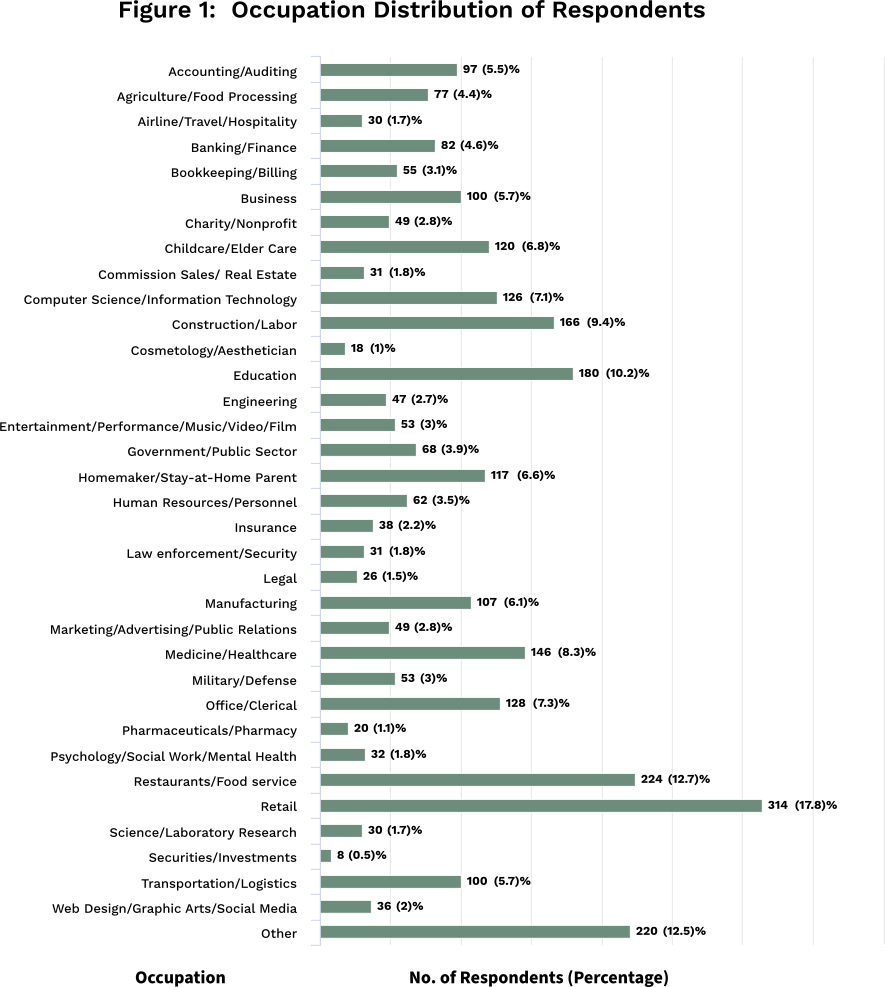
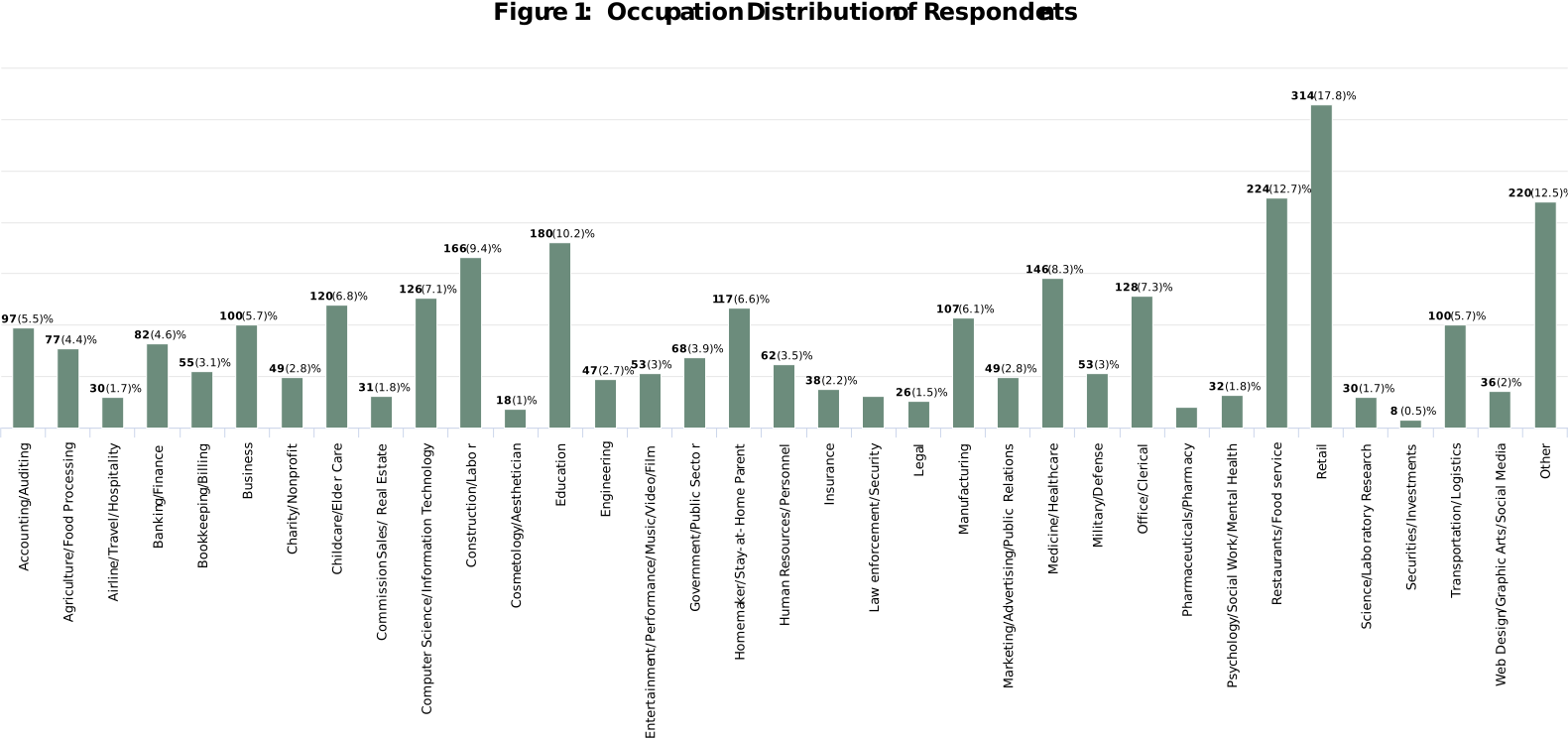
In this vein, we asked respondents to characterize the majority of the jobs they have held. We provided them with a list that encompasses occupational sectors or industries (such as manufacturing, banking/finance, transportation/logistics), as well as some more specific task-oriented positions (such as office/clerical and bookkeeping/billing). The list and the number of respondents working in each of these sectors are in Figure 1.
Occupation and Attitudes
Certain types of attitudes about oneself, others, institutions, and the world at large often correlate with occupation. In some cases, certain jobs attract certain kinds of people. For others, it’s the experience of being exposed to a particular environment while doing a job that shapes one’s attitudes. In most cases, it is some combination of both. We considered both perspectives in the following analysis.
Attitudes Toward Technology
Using occupation to make inferences about someone’s ability to understand technology is the starting point when picking a jury in a patent case. In this vein, we first asked respondents whether they considered themselves to be tech-savvy. Not surprisingly, almost all those who work in computer science/IT and engineering were significantly more likely to consider themselves tech-savvy (Figure 2).
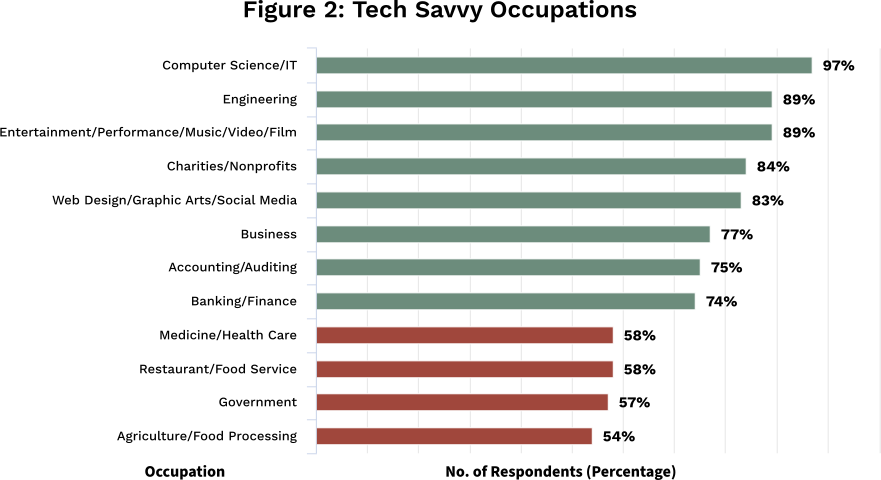
Those who work within the business community are also more likely to consider themselves tech-savvy. These include respondents who have mostly worked in accounting or auditing, banking or finance, and general business.
Additionally, respondents who worked in web design/graphic arts/social media and entertainment/performance/music/video/film were more likely to consider themselves tech-savvy. This is also somewhat expected, as many of the jobs in these fields are largely reliant on technology. Interestingly, those who worked for charities or nonprofits were more likely to consider themselves technologically savvy.
In contrast, the data in Figure 2 show that respondents who work in fields less reliant on technology are less likely to consider themselves technologically savvy. These include: agriculture/food processing, restaurant/food service, government, and medicine/healthcare. The day-to-day work of those in agriculture/food production and restaurants/food service involves little to no technology. While food production often involves automation and factory technology, this technology is not digital and a far cry from consumer-facing digital technologies.
Some jobs in government and healthcare would seem, on the surface, to involve technology on a day-to-day basis. However, on closer inspection, there is more to the story. For example, while many government workers would seem to rely on computers, software, and other office equipment, much of the equipment they use is likely outdated. Most Government agencies, whether local, state, or federal, typically lag behind in adopting the newest technologies due to the constraints associated with public funding. Not surprisingly, people who spend years working in the public sector often find the newest technological developments unfamiliar.
These kinds of constraints likely also influence people in the medical field—such as RNs. LPNs, CNAs, and other hospital staff, as well as many doctors, may occasionally use technology, but their jobs don’t require a detailed understanding of its operation. Even radiology technicians and laboratory technicians may work more closely with technology than others, but the technology they rely on, much like that used by government employees, can be a decade old, if not older.
Similar results appeared when we asked whether respondents follow the latest developments in cutting-edge technologies (see Figure 3). Those whose jobs are the most reliant on technology more closely followed technological developments (i.e., computer science/IT, engineers, web design/graphic arts/social media, and entertainment/performance/ music/video/film). Those in fields least reliant on technology were significantly less likely to follow developing technologies (i.e., child care/elder care, government, medicine/health care, restaurant/food service, and homemakers/stay-at-home parents).
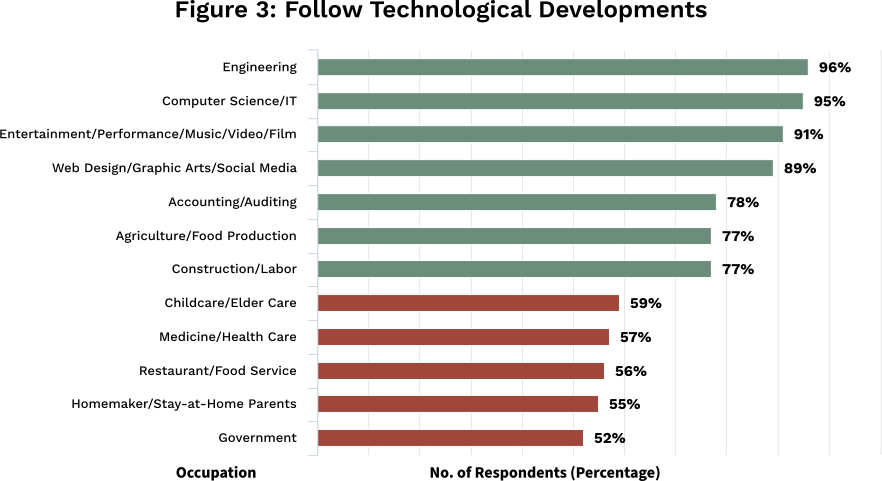
However, there were exceptions to this general rule. Respondents who worked in accounting/auditing, as well as agriculture/food production and construction/labor, were more likely to follow technological developments.
Attitudes Toward Technology Companies
While occupation can reveal insight into people’s experience with and understanding of technology, the question arises whether occupation can reveal more than that. Can it provide insight into someone’s attitudes toward technology companies? For example, are certain types of professionals more likely to be suspicious of large tech companies? Do some tend to favor small tech companies over large ones? Answering these questions can benefit all parties, large and small. A large corporation facing jury selection in an infringement lawsuit brought by a small tech company can benefit from knowing which types of people will be least favorable to it. The converse holds true for small tech companies.
To begin, we asked respondents for their opinions on large technology companies, including Amazon, Apple, Microsoft, Meta, and Alphabet (Google). Results show that significantly more computer science/IT professionals have positive views of Big Tech than others (87% v 72%). Data also show that HR professionals have significantly more positive opinions of Big Tech (87% vs 73%). Moreover, they are at levels virtually identical to computer science/IT professionals.
Why would HR professionals have such positive opinions of large technology companies? For the most part, they are company people. The primary role of HR professionals is to protect the interests of the company. Many employees often view HR professionals differently because when they have a problem, they go to HR to get it resolved. As a result, many employees often view HR as protectors of their rights, rather than the company’s rights. HR professionals see themselves very differently. They do what they do to protect the company. And they are often more likely than most to view situations from the company’s perspective.
We have seen this for years in employment lawsuits where an employee sues their employer. In the many focus groups and mock trials we have conducted on allegations of discrimination or harassment, human resources personnel are, in most cases, reliable defense jurors. They evaluate situations from the company’s perspective. It is a very rare case when an HR professional will be more likely to side with the employee plaintiff. Not surprisingly, plaintiff attorneys typically strike HR personnel during jury selection.
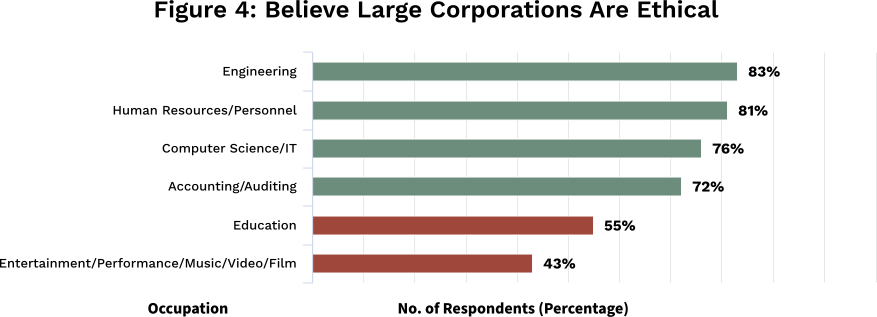
However, data showed that some types of professionals are less likely to think that large technology companies are ethical. Educational professionals, as well as those in the entertainment industry, are significantly less likely than others to believe that large technology companies are ethical.
When it comes to respondents in the entertainment industry, it is no surprise that they direct anti-corporate sentiments toward Big Tech. The entertainment industry has always attracted more creative types than corporate ones. The industry is also well known for its liberal political leanings. In fact, among those surveyed, there were twice as many who identified as Democrats (57%) as there were Republicans (25%). Additionally, nearly half of those surveyed (45%) lived in the Central District of California. As consultants with decades of experience in Southern California, we frequently observe entertainment industry workers expressing suspicion and distrust toward all types of large corporations, not just large tech companies.
What about educators? Prior research has shown that young people, women, and whites are less likely than their counterparts to believe that large technology companies are ethical. Among the surveyed educational professionals, the majority were female (69%), white (62%), and over 45 years old (57%). This may explain some of their distrust. However, the act of teaching or working in education could also engender suspicion toward large tech companies. After all, these companies cultivate the youth market for high-tech gadgets like smartphones and social media apps, despite their potential harm. This has led many educators to feel like they are competing with smartphones for students’ attention in the classroom. This data suggests the fallout from this controversy may affect educators’ thinking about IP cases.
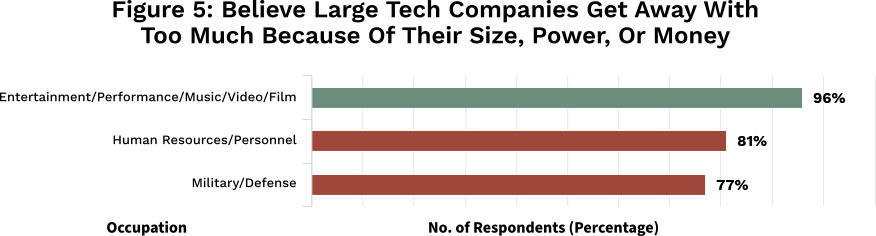
Similar findings were evident when we examined attitudes about general misconduct (see Figure 5). First, we asked respondents if large tech companies get away with too much because of their size, power, or financial resources. Not surprisingly, HR professionals and those in the entertainment industry stood out from the pack. HR professionals were less likely than those in other industries to believe large companies get away with too much.In contrast, those in the entertainment industry were more likely than others to believe large tech companies do.
Respondents who mostly worked for the military or defense industry were also less likely to think large tech companies get away with too much. The fact that career military and defense personnel exhibit pro-corporate attitudes is not surprising, given the political orientation of many in these fields. In this sample, nearly twice as many military/defense respondents identify as Republican as Democrat (51% vs 26%). Additionally, US military organizations are among the largest in the country and instill loyalty in their ranks like no other—as the old saying goes, “Once a Marine, always a Marine.”
Recently, Big Tech has come under fire for alleged monopolistic tendencies. Therefore, we also asked respondents if they thought large technology companies stifle competition (see Figure 6). Not surprisingly, HR professionals were significantly less likely than others to believe that Big Tech stifles competition. Agricultural workers were also less likely to express this opinion. Notably, the majority of agricultural workers identified as Republican (51%), and more than twice as many supported Trump as Harris (64% vs. 26%).
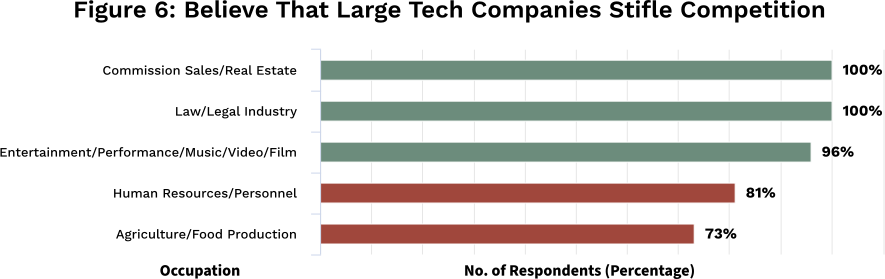
On the flip side, those working in the entertainment industry continued to express their antipathy toward Big Tech and were more likely to believe Big Tech stifled competition. Respondents who worked in two hyper-competitive industries, i.e., commission sales/real estate and the legal industry, agreed. While competitive people may be drawn to these industries, it is likely that working in these highly competitive fields has also influenced their perspective on this subject.
Consider, for example, real estate. Most are independent brokers. They are not employees of large real estate corporations. Nevertheless, they compete on the same playing field with these corporations. They compete for clients and for listings. This landscape can be so competitive that we have seen real estate brokers and those working for small firms justify unethical and even illegal behavior because of the intense competition.
For example, in a recent IP focus group, we heard real estate brokers justify taking contracts, listing documents, and other templates when they leave a job. Departing brokers would take contracts, for example, change a few words and phrases here and there, and use them to start their own business. They justified this behavior by minimizing its importance, e.g., “these contracts are commonplace and all the same,” casting it as normal in the current business environment, e.g., “everybody does it,” and emphasizing its necessity in today’s world, e.g., “it’s tough out there and you’ve got to do whatever you can to make it” or “business is war.”
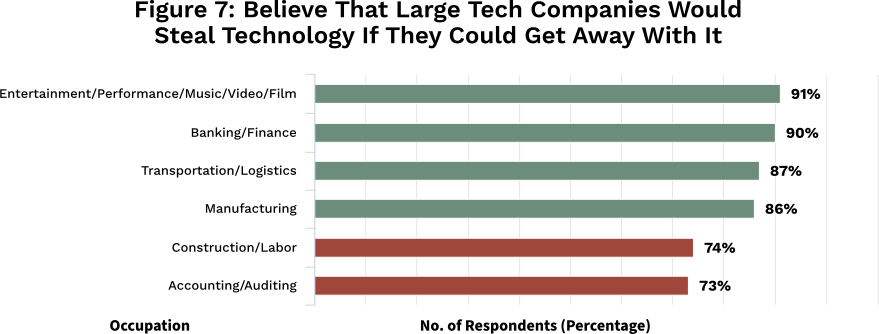
In contrast, those who mainly worked in entertainment, banking/finance, manufacturing, and transportation/logistics were significantly more likely than others to believe that large American technology companies would steal or illegally copy technology if they thought they could get away with it. Agreement among such a diverse mix of occupations is notable, even in light of the fact that more than three-quarters of respondents believed large tech companies would steal technology if they could get away with it.
Somewhat different findings emerged when we asked respondents whether large American technology companies were more likely to steal or illegally copy technology from an individual entrepreneur or small company, rather than from another large American technology company (see Figure 8). Interestingly, only those who mainly worked in education believed they would. Those who worked mostly in accounting/auditing, bookkeeping/billing, computer science/IT, charity/nonprofits, and the military were less likely to believe that a large technology company would be more likely to steal or illegally copy technology invented by a small business or individual entrepreneur.
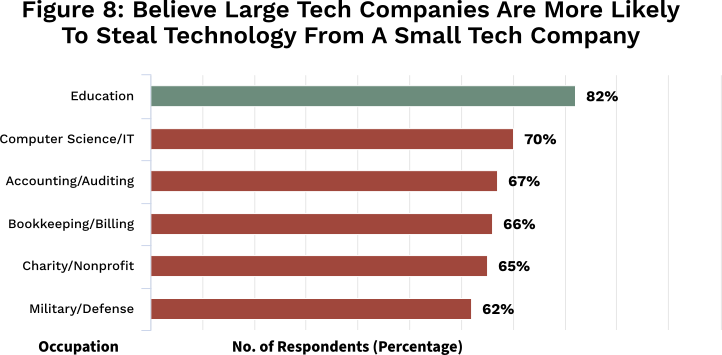
These findings bear discussion because of their implications for whether potential jurors will be receptive to ‘David vs. Goliath’ themes. Individual entrepreneurs or small businesses who sue large tech companies for patent infringement often try to develop a David versus Goliath or underdog theme when arguing their case to the jury. These findings provide insight into which types of jurors will be most and least receptive to this theme. All else being equal, these findings suggest that teachers, school administrators, and the like will be most receptive to this theme. In contrast, these findings suggest accountants, bookkeepers, IT professionals, and military personnel will be the least receptive. Most surprising among these findings is that respondents who have mostly worked at charities or nonprofits would not appear to be receptive to this theme. One would think that in the US, people who work at charities would favor the underdog and would be receptive to the theme of David vs. Goliath, especially since most dedicate themselves to helping those in need.
The disconnect likely arises from the fact that patent infringement involves two private companies. For people who make careers out of helping the disadvantaged, private companies are not victims. Even struggling or failed enterprises are not victims. Those with careers in charities and nonprofits work with REAL victims. They are well acquainted with real victims. Failed capitalists and failed inventors are not real victims. As consultants, we see a similar view being expressed when wealthy plaintiffs sue and attempt to portray themselves as victims. It can often create a backlash. People who have been real victims or work with real victims sometimes find rich plaintiffs lacking in credibility, especially those who lean hard into casting themselves as victims.
America First & Blue-Collar Attitudes Toward Foreign Companies
Looking at someone’s occupation to gain insight into how they feel about foreign tech companies may seem like a tall order. However, with the rise of the MAGA movement, occupation is sometimes viewed as a meaningful indicator of someone’s perspective toward foreign tech companies. Adopting a protectionist agenda, working-class MAGA members often view foreign companies less favorably than their American counterparts.
As a result, some litigators representing foreign companies in lawsuits against American companies tend to believe that prospective jurors who hold blue-collar jobs may be more likely to favor the American company. This often leads litigators to exercise one of their few peremptory challenges to remove them from the panel.
We examined whether blue-collar workers are, in fact, more antagonistic toward foreign companies. We did this in two ways. First, we examined whether they were more likely to be suspicious of foreign tech companies. Second, we examined whether they are more likely to believe that the court system should protect the interests of American tech companies rather than those of foreign tech companies. The working-class occupations included in this analysis are agriculture/food production, construction/labor, manufacturing, and transportation/logistics.
To gauge respondents’ suspicions, we first asked them whether they believed foreign tech companies doing business in the US were more likely than American tech companies to disregard US laws. Results showed that only respondents who worked in construction/labor were more likely to hold this belief (78% vs. 71%). Other blue-collar, working-class respondents were not any more or less likely than others to hold this belief.
We then asked respondents who they thought was more likely to steal or illegally copy technology: American tech companies or foreign tech companies. Results showed that working-class respondents, i.e., those who work in construction, agriculture or manufacturing, and transportation, were NOT more likely to believe that foreign companies had a higher proclivity to steal or illegally copy technology.
Finally, we asked respondents whether they believed the US legal system should protect the interests of American technology companies over those of foreign technology companies doing business in the US. Again, one might expect that those who work in construction, agriculture, and manufacturing would be more likely to advocate this belief. However, the data did not bear this out. In fact, data shows that agricultural and food production workers (70% vs. 83%) were significantly LESS likely than others to hold this America First belief.
To investigate further, we examined whether the political affiliation of blue-collar workers mattered. In other words, do blue-collar Republicans think differently about these issues than blue-collar Democrats? Results showed that they did not. Republican blue-collar workers were no more or less likely than Democratic blue-collar workers to be suspicious of foreign companies or believe that courts should protect the interests of American tech companies over those of foreign tech companies doing business in the US. We also compared blue-collar Republicans to all other respondents and found that their views on foreign tech companies did not significantly differ from those of anyone else.
While it may be that MAGA’s focus on ‘America First’ does not extend to the tech sector, the data suggest that these kinds of ‘America First’ beliefs are much more widespread than many would expect. For example, the vast majority of respondents (83%) believe that courts should protect the interests of American tech companies over those of foreign tech companies. This suggests that foreign tech companies may find litigating cases against American tech companies particularly challenging, regardless of whether they are in a red or blue venue (see also “Juror Attitudes Toward High Tech Companies in Patent Litigation,” DOAR Research Center, 2025).
Key Takeaways
Occupation is an important consideration when evaluating the risks posed by prospective jurors in IP cases. Moreover, these data show that they can give insight not only into their technological sophistication or interest, but also into their attitudes about large technology companies and the theft of technology. Time and time again, what respondents do for a living significantly affected their views on these subjects. Prior research conducted by the DOAR Research Center indicates that age has the greatest impact on attitudes toward technology, technology companies, and patent infringement. Simply put, young people think much differently about these issues than older people do. Nevertheless, the effects of occupation remain significant, and in some cases rival the impact of education, income, racial/ethnic affiliation, and venue.
What lessons can be learned from this research? First, consider computer science and IT professionals. These individuals have always received special attention from litigators because, on average, they are the most technologically sophisticated, most likely to understand the technology behind high-tech patents, and most likely to be able to teach that technology in the jury room. The data here are consistent with these hypotheses. Computer science and IT professionals were the most likely to consider themselves technologically savvy and the most likely to follow the newest developments in technology.
However, this data shows that the technological sophistication these professionals bring to bear does not equally benefit all parties in patent litigation. Computer science and IT professionals are more likely than others to have positive opinions of Big Tech, more likely to believe large technology companies are ethical, and less likely to think large technology companies steal technology from individual entrepreneurs or small tech companies. However, the favorable opinions of large technology companies are not without their limits. Despite these favorable opinions, computer science and IT professionals are more likely than others to believe that American tech companies have a higher proclivity for stealing or illegally copying technology than foreign tech companies. Overall, these data suggest that computer science and IT professionals will be better jurors for large technology companies rather than small ones, and some, may be better for foreign tech companies, as opposed to American ones.
Interestingly, human resources professionals also showed themselves to be more favorable to Big Tech than others. HR professionals are more likely to a) have a positive opinion of Big Tech, b) believe Big Tech is ethical, c) believe large technology companies do NOT stifle competition, and d) believe large technology companies do NOT get away with too much because of their size, power, and money. These attitudes likely have little to do with technology per se than general pro-corporate attitudes shared among HR professionals—attitudes well known among lawyers who litigate employment disputes.
Accountants and auditors tended to be more favorable to Big Tech than others. Accountants/Auditors are more likely to a) believe large technology companies are ethical, b) believe large technology companies will not steal or illegally copy technology if they can get away with it, c) believe large technology companies do NOT stifle competition, and d) believe large technology companies will NOT steal or illegally copy technology from an individual entrepreneur or small tech company.
Other respondents who displayed at least some favorability towards Big Tech on specific issues included: engineers, military/defense professionals, construction workers, agriculture/food production workers, those in bookkeeping/billing, and those who work for charities and nonprofits. Notably, among this group, only agricultural/food production workers are significantly less likely than others to consider themselves tech savvy.
Those who held the most unfavorable attitudes toward Big Tech, worked in the entertainment industry. These are performers or they work in the video or film industries. They are more likely than others to a) believe large technology companies are NOT ethical, b) think Big Tech stifles competition, c) believe large technology companies get away with too much because of their size, power, and money, and d) believe large technology companies will steal or illegally copy technology if they can get away with it. Not surprisingly, many of these respondents lived in the Central District of California. Therefore, they are a notable risk for lawyers representing large technology companies in Southern California.
Other jobs are also critical of big tech. Teachers and others who work in education also deserve special attention here, as they too tend to be more critical of Big Tech. They are more likely to believe that large tech companies are NOT ethical and are more likely to steal technology from a small company or individual entrepreneur.
Aside from general views of Big Tech and their conduct, the data show that certain types of people are more likely to be receptive to common themes argued in patent litigation. The first is the David vs. Goliath theme. Smaller tech companies that find themselves in a lawsuit with a larger tech company often try to develop this theme when presenting their case in court. They cast themselves as the underdog, severely outmatched, and often bullied by a larger counterpart. The data in this survey suggest that teachers and others who work in education will be receptive to this theme. They are more likely to believe large tech companies would steal or illegally copy technology from an individual entrepreneur or small tech company.
In contrast, data suggest that certain people would be less receptive to these arguments. This includes computer science and IT professionals, accountants and auditors, bookkeepers and those who work in billing, as well as career military and defense industry professionals. Each is less likely than others to believe large tech companies would steal from small ones.
Interestingly, data also suggests that those who work in charities and nonprofits would be less receptive to David and Goliath themes in IP litigation. On the surface, this appears to be contrary to expectations. Shouldn’t people who work for charities and nonprofits be more empathetic and sensitive to how others can be treated unfairly? As discussed previously, this likely has to do with the types of people charities and nonprofits help—the homeless, unemployed, disabled, victims of domestic abuse, etc. For someone who has worked most of their career in charities and nonprofits, these are the REAL victims. Many would be hard-pressed to find an inventor or small tech company that qualifies. This can be exacerbated when litigators cross that line and lean too heavily into victim language. Developing an effective David vs. Goliath theme requires much more nuance and deftness in IP litigation than it does in a personal injury or tort litigation—especially when the audience works with so-called REAL victims.
Another common theme in IP litigation focuses on the anti-competitive monopolist. Monopolist themes are often developed by defendants accused of infringement. They involve stories about inventors who built a better mouse trap but were frivolously sued by, most typically, a large company that sought to maintain its control over the market. Jurors will often be told that this is not a case about infringement; rather, it is a case about a company attempting to keep a competitor out of the marketplace by making frivolous accusations.
Data from this survey suggest that those who work in the entertainment industry (performers and those who work in video or film), as well as those who work in commission sales, real estate, and the law, will be the most receptive to arguments decrying the actions of a Big Tech monopolist. Entertainment industry workers are simply suspicious of everything Big Tech. Those who work in commission sales, real estate, and the law are not. What they are are people who work in hypercompetitive fields. They, more than most, understand how big competitors can dominate the playing field.
Interestingly, America First themes did not resonate more with working-class people in these venues than with other people. Although construction workers and laborers expressed some suspicion of foreign companies, respondents who worked in manufacturing, agriculture, food production, transportation, and logistics were not more likely than others to hold America First beliefs—at least those studied here. This does not suggest that America First beliefs were waning. In fact, the opposite is true. This data suggests they are more widespread than typically believed.
The current political landscape makes it challenging for foreign tech companies to litigate IP cases in American courts. This places more importance on jury selection and identifying jurors who will be biased toward foreign companies. Knowing someone’s occupation and their political leanings may not be enough. Looking for more direct evidence of suspicion or antipathy toward foreign tech companies would be necessary. This requires designing and proposing questions that target this bias and using social media searches to locate more explicit America First or MAGA posts.
In the end, knowing what a prospective juror does for a living is not the whole story, but it is a valuable piece of information that can tell us much more than how well he/she will understand the law and the technology at issue. They can provide insight into how prospective jurors think about large and small tech companies as well as American and foreign tech companies. This is not only true for computer science and IT professionals but educators, HR professionals, entertainers, video/film workers, accountants and auditors among others. Only when we incorporate such lessons into our calculus of evaluating prospective jurors can we maximize the chances of producing favorable outcomes at trial.
[1] As is common in market research databases, Hispanics were underrepresented in each venue. Additionally, the CDCA sample included more degree-holding respondents than are present in the venue, i.e., roughly 41% versus 30%). Also, the EDTX sample consisted of significantly more women than men, with roughly 68% of the 107 respondents being women. Given the paucity of empirical research conducted in the Marshal Division after Judge Gilstrap issued his standing order, we decided to obtain the largest sample size possible. Each of these issues was taken into account in the analysis, the interpretation of the results, and the conclusions.


Following the 2024 presidential election, the DOAR Research Center conducted a national survey revealing a shift in how jurors view white-collar cases.
In a changing patent litigation landscape, the DOAR Research Center studied how jurors view high-tech companies across key venues.

The DOAR Research Center conducted a national study to understand how jurors evaluate trade secret disputes in today’s workplace environment.

The DOAR Research Center examined how jurors respond to free speech arguments amid growing polarization and debate over the First Amendment.

Amid growing concern over drug pricing and the opioid crisis, the DOAR Research Center studied public attitudes toward pharmaceutical companies.
The DOAR Research Center examined how jurors approach workplace harassment and discrimination claims in the post-#MeToo era.